
Learn
Gemstone or Diamond? How to Decide What's Right for You
Choosing between a gemstone and a diamond? Both are real, both are certified. A calm guide to deciding by colour, occasion and meaning, from Aurea.
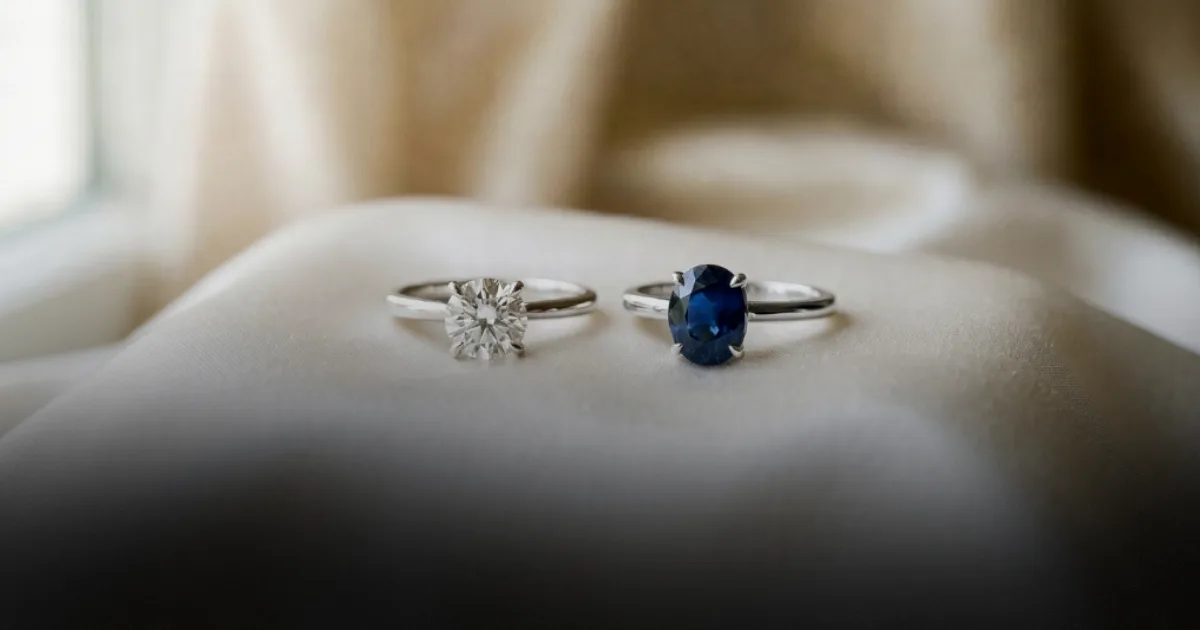
Most people arrive at this decision expecting a trade-off, as though choosing a coloured gemstone means settling for less than a diamond, or choosing a diamond means playing it safe. We would rather you set that framing aside. A gemstone and a diamond are not two rungs on the same ladder — they are two different answers to the same question: what do you want to see when you look down at your own hand. At Aurea, every stone we set, coloured gemstone or diamond, is grown rather than mined, and every one arrives certified. Neither is the entry point, and neither is the reward for spending more.
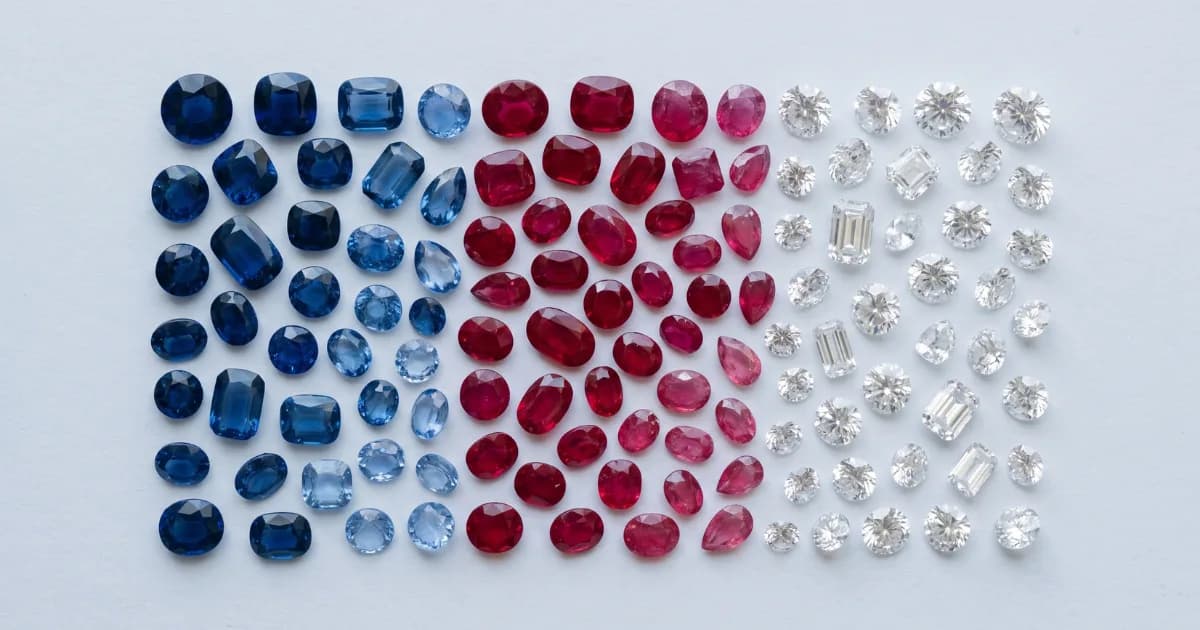
This guide works through the questions that tend to make this decision for most people — what the piece is for, how you will wear it, what colour means to you, and what you want it to say — without pretending one stone outranks the other.
Begin With What the Piece Is For
Before colour or stone type, it helps to answer a plainer question: what is this piece actually for. A piece you intend to wear most days — to work, to dinner, absent-mindedly while doing everything else — asks something different of a stone than a piece kept for particular evenings. A piece bought to mark a specific milestone, an anniversary, a promotion, or simply the decision to finally buy something for yourself, carries a different kind of weight than something chosen because it caught your eye in passing.
None of this determines diamond or gemstone on its own, but it narrows the real question from “which is better” to “which fits this particular piece, worn this particular way.”
Both Are Real, Both Are Certified — Set the Old Assumption Down
A lingering assumption still trips people up here: that a lab-grown stone, coloured or colourless, is somehow a lesser or synthetic substitute, closer to cubic zirconia than to a “real” stone. It is worth addressing directly, because it is not accurate. The Gemological Institute of America (GIA) states that a laboratory-grown diamond has “essentially the same chemical, physical and optical properties” as one formed underground, with the difference lying in “very subtle differences that can only be detected by trained gemologists” using specialised equipment (GIA, n.d.). GIA is equally clear that this is a different category entirely from a diamond simulant: materials such as cubic zirconia “may flash and dazzle like a diamond,” but are not diamonds at all, whereas a lab-grown stone shares diamond's “same crystal structure, consisting of tightly bonded carbon atoms” (GIA, n.d.).
The International Gemological Institute (IGI) grades lab-grown diamonds on the same 4Cs used for natural stones — colour, clarity, cut and carat — describing them as “optically, chemically, and physically identical” to their mined counterparts (IGI, n.d.). Coloured gemstones follow the same principle: a lab-grown sapphire or ruby is chemically identical corundum, not a stand-in for one. This is also, formally, a matter of consumer protection. The US Federal Trade Commission requires that any laboratory-grown stone be disclosed as such, immediately before the word “diamond” or the gemstone's name, with equal prominence — a rule built to keep sellers honest, not to suggest the stone itself is diminished (FTC, n.d.). At Aurea, that disclosure and certification travel with every piece as standard, because a stone's origin should be a fact you are given plainly, not a detail you have to ask for.
Colour Is a Style Decision, Not a Consolation Prize
Once the “real or not” question is settled, the choice becomes far more personal, and far more interesting. GIA's own guidance to buyers considering a coloured centre stone is direct: “color is king” (GIA, n.d.). A sapphire's blue, a ruby's red, an emerald's green each carry their own association — GIA notes sapphire has long stood for “sincerity, truth and faithfulness” — but the honest starting point is simpler than symbolism: which colour do you actually want to wear against your skin, your other jewellery, and your wardrobe, for years to come.
A diamond's appeal runs in the opposite direction: not a colour choice at all, but a commitment to brilliance without one, a quiet, colourless clarity that some people find suits everything precisely because it asks nothing of what is around it. Choosing colour over colourless, or the reverse, is not a smaller decision than choosing a diamond by default. It is the decision.
Consider How You Will Actually Wear It
Durability is a fair, practical question to bring into this, though it points to a real difference worth understanding rather than a reason to rule anything out. Diamond sits at 10 on the Mohs hardness scale, the hardest known natural material, and a lab-grown diamond shares that hardness exactly, being chemically identical to a mined one. Ruby and sapphire, both varieties of corundum, sit at 9 on the same scale, which GIA describes as “excellent for daily wear.” Other coloured stones vary more widely, and GIA points out that hardness is only one of three factors worth weighing, alongside toughness (resistance to chipping) and stability (resistance to chemicals, light and heat) — noting that some gems, however striking, are “best reserved for special occasions, not everyday wear” (GIA, n.d.).
In practice, this simply means matching the stone to the life the piece will lead: a ring worn daily benefits from a hard, tough, stable stone, whatever its colour, while a pendant or a pair of earrings kept for occasions has more room to be chosen purely on how it looks. This is a question of habits, not hierarchy — and it applies as much within the coloured-gemstone category as it does between gemstone and diamond.
What Each Tends to Say, Without Deciding for You
As a useful shorthand: a diamond tends to read as classic and unhurried, a brilliance without a specific colour attached to it, which is part of why it pairs easily with almost anything and rarely dates. A coloured gemstone tends to read as more particular, a decision that says something specific about the wearer, whether that is a favourite colour, a birth month, or simply a preference for jewellery that looks like nobody else's. Neither reading is more sophisticated than the other, and plenty of pieces are chosen precisely to cut against type — a diamond bought for its quiet informality, or a deep-coloured stone bought as the one considered, classic piece someone wears for years. Treat these as starting impressions, not rules.
If This Is a Gift, Not Just for You
That context can make the colour-versus-diamond decision easier, not harder. A coloured gemstone tied to a birth month or a shared memory can carry meaning a diamond does not reach for, while a diamond's classic, unattached brilliance can be the safer, still-thoughtful choice when you are choosing for someone whose preferences you are still learning. Either way, the same standard applies: grown, certified, and made only once the piece is confirmed.
How Aurea Makes This Easier
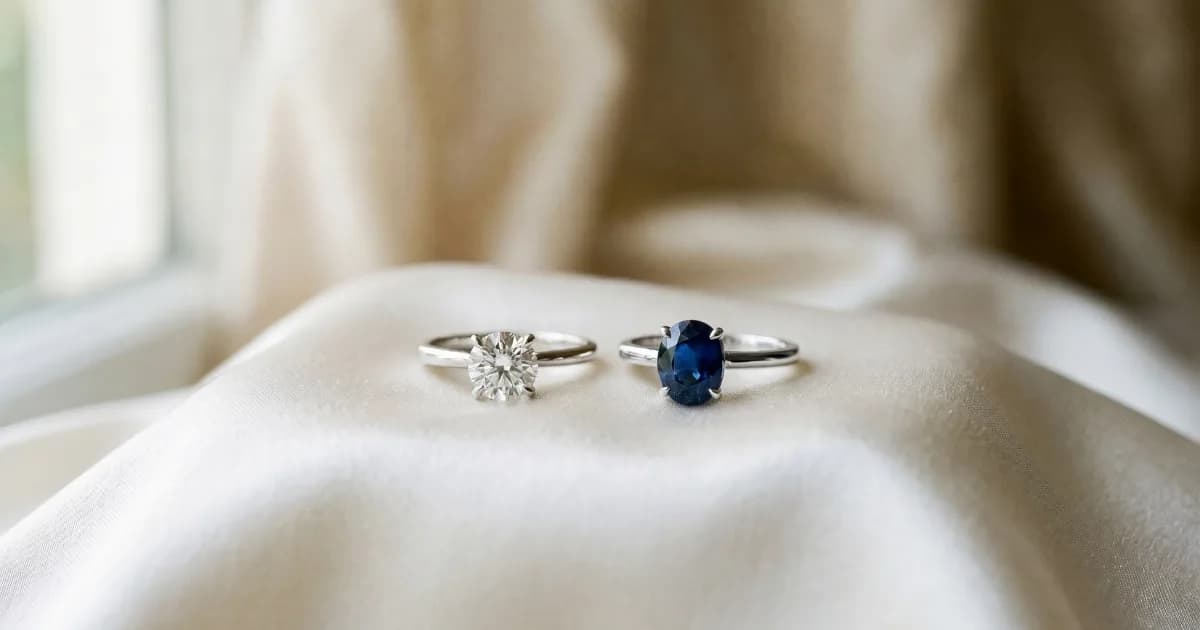
We built Aurea around the idea that this decision should not feel like a test. Our styles are available across both coloured gemstone and diamond, priced in yen and US dollars, with the two presented as equal, standard options rather than a premium tier and a budget one. Each piece is made only once it is ordered — nothing sits finished in a drawer waiting for a buyer — and takes approximately 20 days to craft before it is dispatched from Singapore, tracked the whole way to Japan or wherever you are.
If you would rather be guided than choose alone, Find Your Piece asks five short questions about occasion and personal style and suggests pieces worth a closer look, and a complimentary consultation puts an actual jeweller on the other end, with no pressure to decide on the spot.
Frequently Asked Questions
Is a lab-grown gemstone as real as a mined one?
Yes. A lab-grown sapphire, ruby, or diamond shares the same chemical composition and physical structure as its mined counterpart. Only its origin differs, and that origin is disclosed on its certificate as standard.
Does choosing a coloured gemstone mean paying less than a diamond?
Not at Aurea. Coloured gemstone and diamond are presented as equal, standard offerings across the collection — the choice is about colour and design, not budget. Diamond pieces do tend to sit a little higher in price generally, but neither category is positioned as the cheaper option.
Which is more durable for everyday wear, a diamond or a coloured gemstone?
Diamond, at 10 on the Mohs hardness scale, is the hardest option available. Ruby and sapphire, at 9, are also considered excellent for daily wear; other coloured stones vary, so it is worth weighing hardness, toughness and stability together with how often a piece will actually be worn.
How do I know if a diamond or gemstone is genuinely certified?
A genuine certificate comes from an independent gemological laboratory, states the stone's origin — natural or laboratory-grown — plainly, and can usually be verified against a report number. Every piece at Aurea ships with its certificate included.
A Considered Next Step
There is not a wrong answer here, only the one that actually fits how you live and what you want to see when you look down. If you would like company while you decide, take five minutes with Find Your Piece, or book a complimentary consultation — a jeweller who can talk through colour, stone, and setting with you directly, at your own pace.
Theo Lindqvist
Writes about stones, for Aurea
Theo answers the questions people ask before they buy — about origin, certification, and what a stone actually is. He'd rather a piece read plainly than impressively.
The 4Cs of Diamonds, Explained Simply | Aurea
A clear, calm guide to the 4Cs of diamonds — cut, colour, clarity, and carat — and how they apply equally to lab-grown stones. From Aurea.
What a Diamond Certificate Actually Tells You | Aurea
What does a diamond certificate actually mean? A clear guide to the 4Cs, GIA and IGI reports, and why certification applies equally to lab-grown stones.
How durable a lab-grown stone is, and how to look after it
A lab-grown diamond is exactly as hard and as durable as a mined one — care is the same, too.