
Learn
The 4Cs of Diamonds, Explained Simply | Aurea
A clear, calm guide to the 4Cs of diamonds — cut, colour, clarity, and carat — and how they apply equally to lab-grown stones. From Aurea.
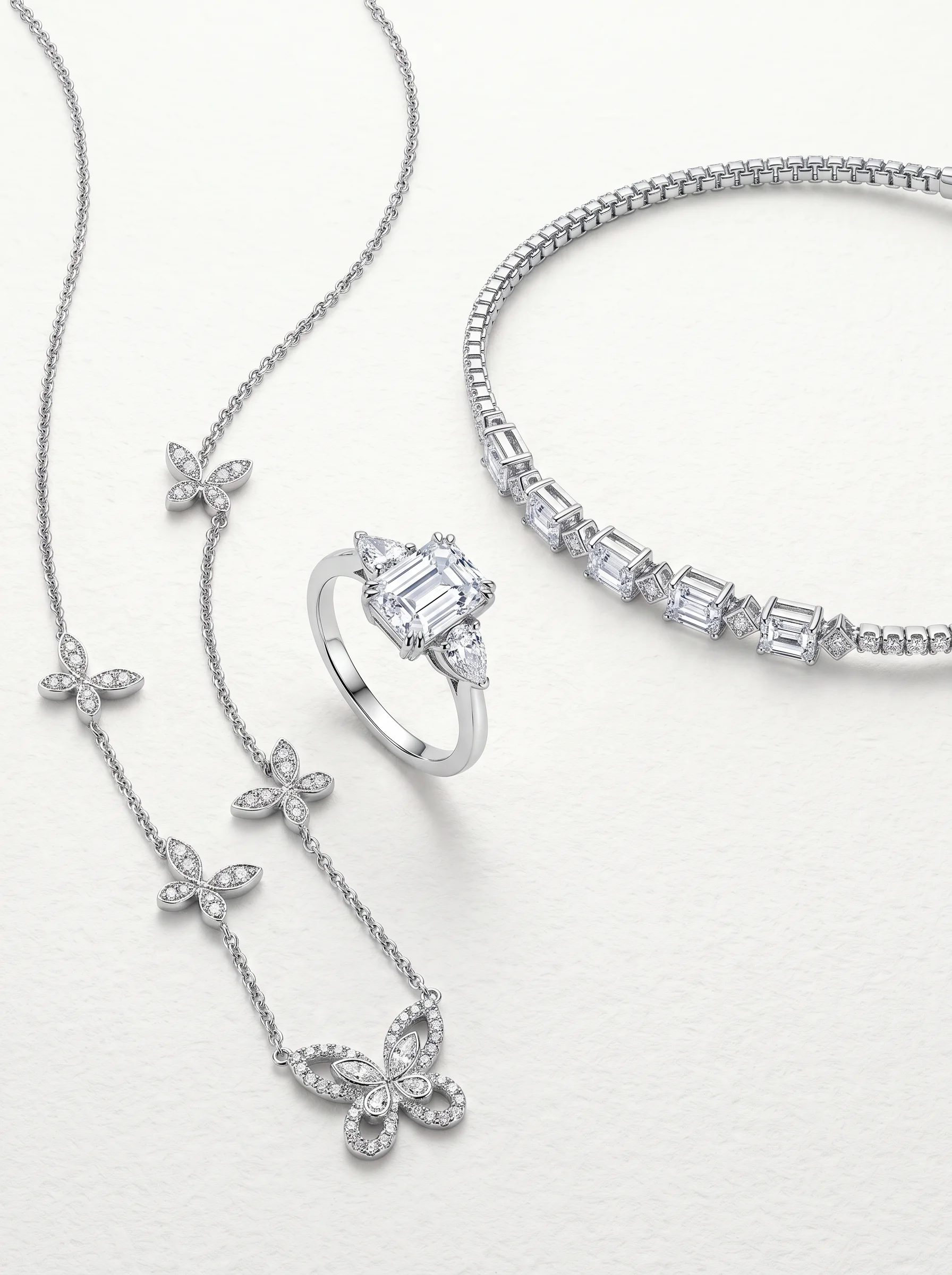
Ask most first-time buyers what makes one diamond different from another, and the honest answer is that they are not quite sure, and would rather not admit it. That is a perfectly reasonable place to start from. The 4Cs — cut, colour, clarity, and carat — exist because diamonds are genuinely difficult to compare by eye alone, and because a shared vocabulary lets a buyer, a jeweller, and an independent laboratory all describe the same stone in the same terms. None of it is complicated once it is unpacked slowly, and none of it requires becoming a gemologist before you can choose with confidence.
This guide works through each of the 4Cs in plain terms, addresses the question we hear most often — whether the same standards apply to lab-grown diamonds — and leaves you with enough vocabulary to have a comfortable, informed conversation about a stone, whether that conversation happens in a consultation, across a counter, or entirely on your own.
Cut: The One That Decides How a Diamond Actually Looks
Of the 4Cs, cut is the only one that describes what was done to a stone rather than a property it arrived with. It refers to how precisely a diamond's proportions, symmetry, and facets are shaped and arranged to catch and return light. The Gemological Institute of America (GIA), which developed the 4Cs system, calls cut “one of the most obvious Cs to the untrained eye” and notes it is “most likely to be the first thing someone notices when looking at a diamond,” because it governs brightness and sparkle more directly than colour or clarity do (GIA, n.d.). A diamond cut too shallow or too deep loses light out of its sides or base instead of returning it to the eye, regardless of how strong its colour or clarity grade looks on paper. This is why two diamonds with identical colour and clarity grades can still look noticeably different once they are actually on a hand.
Colour: Judged on an Absence, Not a Presence
Diamond colour is graded on a scale running from D to Z, where D is the most colourless and each subsequent letter reflects a faint but detectable warmth creeping in, typically pale yellow or brown. The American Gem Society notes that colour “ranges from colorless to light yellow or light brown,” with colourless considered the rarest (American Gem Society, n.d.). Grading happens by comparing a stone against a set of master diamonds under controlled lighting, which is why it is a laboratory task rather than something reliably judged with the naked eye — most colour differences between adjacent grades are effectively invisible unless a diamond is compared directly against a known reference.
Clarity: What's Inside, and How Much It Matters
Clarity describes the presence of inclusions (internal characteristics) and blemishes (external ones), most of which formed naturally as the stone crystallised and are invisible without magnification. GIA defines clarity simply as “the amount, size, and location of inclusions and blemishes” (GIA, n.d.), assessed by graders working at fixed magnification. It is worth saying plainly: very few clarity grades are visible to an unaided eye, even toward the lower end of the scale. Two diamonds a full clarity grade apart can look identical across a room, which is one reason clarity is often where a buyer can make the most practical trade-off without sacrificing anything they would actually notice while wearing the piece.
Carat: A Measure of Weight, Not of Size
Carat is the simplest of the 4Cs to define and the easiest to misread: it measures a diamond's weight, not its visual size. The American Gem Society notes that “one carat equals 1/5 gram and is subdivided into 100 points” (American Gem Society, n.d.). Two diamonds of identical carat weight can appear different sizes depending on how they are cut — a well-proportioned stone can look larger, and a poorly cut one can look smaller, than its carat weight alone would suggest. This is the clearest illustration of why the 4Cs work as a set rather than as four separate scores: carat tells you what a diamond weighs, and cut tells you what it does with that weight.
So Which C Matters Most?
This is the question we hear more than any other, and GIA's own answer is refreshingly honest: “it depends” (GIA, n.d.). If sparkle and brilliance matter most to you, cut carries the greatest visual weight. If size within a set budget is the priority, carat and clarity are often traded off against each other, since a slightly lower clarity grade can free up budget for a larger stone without a visible difference in appearance. There is no universally correct order, only the order that reflects what you personally notice and value. This is exactly the kind of decision our consultations exist for — talking through the trade-offs against one specific piece, rather than treating the 4Cs as a test with a single right answer.
Do the 4Cs Apply to Lab-Grown Diamonds?
Yes, and this is worth stating plainly rather than in passing: a lab-grown diamond is graded on cut, colour, clarity, and carat because it is, physically, a diamond — the same carbon crystal structure, the same hardness, the same fire as a mined stone. Origin is the only fact that differs, and it is recorded separately, not folded into the 4Cs themselves.
That said, one detail is worth knowing if you ever compare two certificates side by side. The International Gemological Institute (IGI) grades lab-grown diamonds on the identical D-to-Z colour range and the same clarity scale used for natural stones, stating that its gemologists “analyze color in the D to Z color range” for lab-grown certification just as they do for natural diamonds (IGI, n.d.). GIA, by contrast, changed its approach for lab-grown stones in 2025: rather than assigning a specific letter and number grade for colour and clarity, it now classifies lab-grown diamonds as either "Premium" or "Standard," based on a combined assessment across colour, clarity, and finish. GIA's stated reasoning, per chief laboratory officer Tom Moses, is that "more than 95% of laboratory-grown diamonds entering the market fall into a very narrow range of color and clarity," making the finely graduated scale built for the wide natural variation of mined stones less useful for describing them (GIA, 2025). Neither approach says anything about which stone is better — they are two laboratories presenting the same underlying facts in different formats. At Aurea, every diamond and every coloured gemstone we set is lab-grown and certified as standard, and its certificate states its 4Cs, or its Premium/Standard classification, plainly.
What About Coloured Gemstones?
The 4Cs, strictly speaking, is a diamond-specific framework. Coloured gemstones such as sapphire, ruby, and emerald are assessed on similar territory — colour, clarity, cut, and carat all factor into how a coloured stone is judged — but there is no single, universally standardised numerical scale the way there is for diamond colour and clarity. Gemmological grading typically describes coloured-stone colour using hue, tone, and saturation rather than a letter grade, and clarity expectations vary meaningfully by gemstone type, since some stones naturally carry more visible inclusions than others even at a fine quality (GemSociety, n.d.). This is one reason Aurea presents lab-grown gemstone and lab-grown diamond as equal, standard choices rather than ranking one above the other: they are judged by different, appropriately suited standards, not by a shared scorecard.
Putting the 4Cs to Use
None of this is meant to turn choosing a piece into homework. In practice, the 4Cs are most useful as a shared vocabulary — a way to understand what a certificate is actually telling you, and to have a specific, informed conversation about a stone rather than a vague one. If you already have a sense of your budget, our Find Your Piece quiz asks a handful of simple questions about occasion and personal style, with comfortable ranges from under ¥40,000 ($260) up to above ¥250,000 ($1,600), and suggests pieces worth a closer look. If you would rather talk it through directly, a complimentary consultation puts an actual jeweller on the other end, happy to walk through what the 4Cs mean for one specific piece, rather than in the abstract.
Frequently Asked Questions
What are the 4Cs of diamonds?
The 4Cs are cut, colour, clarity, and carat weight — the four standardised characteristics gemological laboratories use to describe and grade a diamond, developed originally by GIA.
Which of the 4Cs is most important?
There is no single correct answer; it depends on personal priority. Cut has the greatest effect on sparkle and brilliance, while carat and clarity are often traded off against each other within a set budget.
Do lab-grown diamonds have the same 4Cs as natural diamonds?
Yes. A lab-grown diamond is graded on cut, colour, clarity, and carat because it is physically a diamond. IGI uses the identical D-to-Z colour and standard clarity scales for both natural and lab-grown stones; GIA now classifies lab-grown diamonds as "Premium" or "Standard" instead of assigning a specific letter grade.
Do coloured gemstones have a 4Cs grading scale too?
Not in the same standardised, numerical sense. Coloured gemstones are assessed on similar territory — colour, clarity, cut, and carat — but colour is typically described using hue, tone, and saturation rather than graded on a universal letter scale.
Does carat weight determine how big a diamond looks?
Not on its own. Carat measures weight, and cut quality has a major effect on how large a diamond appears for its weight, so two diamonds of the same carat can look different sizes.
A Considered Next Step
Understanding the 4Cs is not about chasing a perfect score on paper. It is about having the vocabulary to ask the right questions and choose with confidence, in your own time. If you would like to talk a specific piece through with a jeweller, book a complimentary consultation, or spend a few minutes with Find Your Piece to narrow things down first. Either way, every stone at Aurea, diamond or coloured gemstone, arrives certified, with its 4Cs, or its classification, stated plainly.
Cut
The biggest single factor in how much a stone sparkles.
Colour
How close to colourless a white diamond is.
Clarity
Natural inclusions formed during crystal growth.
Carat
Weight, not size.
Theo Lindqvist
Writes about stones, for Aurea
Theo answers the questions people ask before they buy — about origin, certification, and what a stone actually is. He'd rather a piece read plainly than impressively.
What a Diamond Certificate Actually Tells You | Aurea
What does a diamond certificate actually mean? A clear guide to the 4Cs, GIA and IGI reports, and why certification applies equally to lab-grown stones.
How durable a lab-grown stone is, and how to look after it
A lab-grown diamond is exactly as hard and as durable as a mined one — care is the same, too.
A lab-grown stone holds the same certified grading as a mined one — how that translates to resale is still a developing, less established market than for mined stones.