
Education
How to Find Your Ring Size at Home
A calm, practical guide to measuring your ring size at home using string, paper, or a ring you own — plus how Japanese sizing differs.
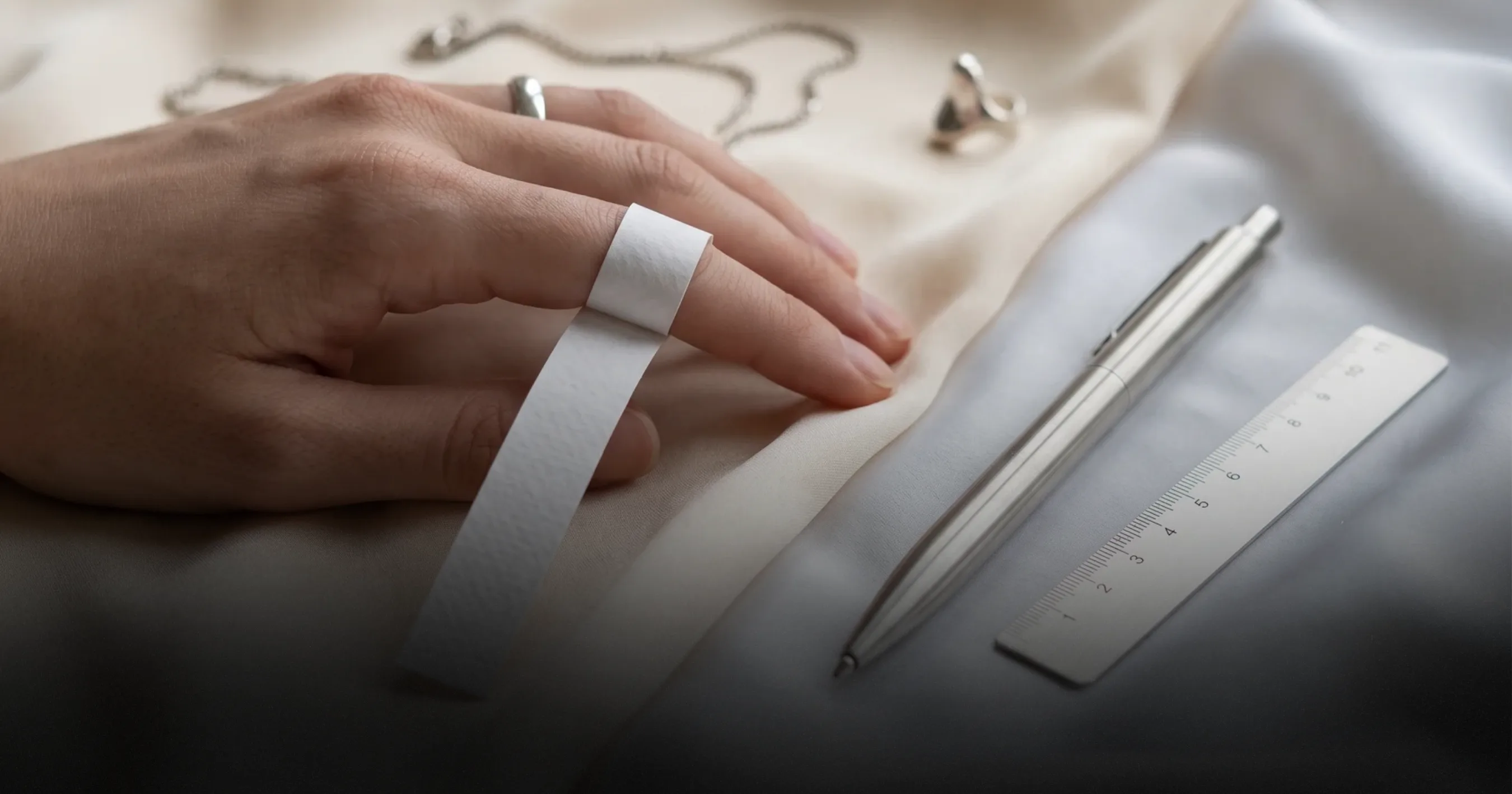
Buying a ring without trying it on first can feel like the one part of shopping online that still needs a shop counter. It largely doesn't. Ring size is one of the few measurements you can take accurately at home, in a few minutes, using things you probably already have in a drawer. This guide walks through the two most reliable at-home methods, the small conditions that quietly throw a measurement off, and what to know if you're ordering to Japan, where ring sizes are counted on an entirely different scale.
Why It's Worth Getting Right Before You Order
At Aurea, every ring is made only once it's ordered — cut, set, and finished for you rather than picked from a stockroom shelf and swapped on the spot. That's part of what keeps the collection considered rather than mass-produced, but it also means the size on your order matters more than it would with a ready-made ring tried on in person. A few careful minutes spent measuring before you order is the simplest way to make sure a Solitaire, Bloom Halo, Cushion Halo, or Trilogy ring fits comfortably the day it arrives.
None of this needs specialist equipment or a trip anywhere. A ring size, unlike most other fine-jewellery measurements, can be worked out at home with ordinary household items and a few minutes of patience — the same approach jewellers themselves rely on as a starting point before confirming a fitting in person. The two methods below cover most people's situations: one for when you're measuring your own finger directly, and one for when you already own a ring that fits the way you'd like the new one to.
The String or Paper Method
The most familiar way to measure ring size at home uses a strip of string, ribbon, or paper roughly 15 centimetres long, along with a pen and a ruler.
Wrap the strip snugly around the base of the finger you'll wear the ring on — the point where the ring will actually sit, not further up.
Mark the strip with a pen where the two ends meet.
Lay the strip flat and measure the marked length in millimetres.
Divide that number by 3.14 (pi) to find the diameter, then compare both the circumference and diameter figures against a standard ring size chart (Blue Nile, n.d.).
It's a genuinely useful starting point, which is why the method is so widely recommended. It's also worth knowing its limits before relying on it entirely. The Gemological Institute of America (GIA) cautions that string and paper aren't the most exact tools for the job, since “string can stretch and paper can be easily damaged,” and that humidity or temperature can cause paper to shrink or curl while you're working with it (GIA, n.d.). Treat the result as a close estimate rather than a final answer — particularly for a piece that will be made specifically to that number.
Measuring a Ring You Already Own
If you already own a ring that fits the intended finger well — ideally the same hand and finger the new ring is meant for — measuring it directly is usually more reliable than measuring your finger itself.
Chart method. Place the ring flat over a printed set of circles on a ring size chart until its inner edge lines up exactly with one of the circles (Brilliant Earth, n.d.).
Ruler method. Measure straight across the inside of the band to get the internal diameter, then match that figure to a chart.
Ask a jeweller. A jeweller can measure a ring precisely on a mandrel — a tapered, graduated rod made for exactly this — in a matter of seconds (GIA, n.d.).
One detail worth remembering if you're borrowing someone else's ring to work out their size: hands aren't perfectly symmetrical. The GIA notes that a left ring finger is typically about half a size smaller than the right (GIA, n.d.), so measure a ring from the hand and finger the new piece is actually intended for, not whichever hand happens to be convenient.
Small Details That Change the Result
A few ordinary conditions can shift a measurement enough to matter:
Time of day. Fingers tend to be smallest in the morning and largest later in the day, once normal activity and warmth have caused them to settle. Measuring toward the middle or end of the day tends to give the truer read (Brilliant Earth, n.d.).
Temperature. Cold fingers shrink; warm fingers expand. Measure at a normal, comfortable room temperature rather than straight after being outdoors in the cold or after a hot shower (Brilliant Earth, n.d.).
Knuckles. If a knuckle is noticeably larger than the base of the finger beneath it, measure both and choose a size that lets the ring pass over the knuckle without force while still sitting snugly once it's on (Brilliant Earth, n.d.; Blue Nile, n.d.).
Band width. A wider band takes up more surface area against the finger and generally needs to be sized up slightly compared with a slim band measured on the same finger (Blue Nile, n.d.).
Repeat it. Measure two or three times, ideally on separate occasions, and trust the most consistent result rather than the first one you get (Blue Nile, n.d.).
Ordering to Japan: A Note on Sizing Conventions
Ring sizing isn't measured the same way everywhere, and Japan is a useful example of why that matters. The United States and Canada use a numbered scale, the United Kingdom and Australia use letters, and Japan uses its own separate numbered system, typically running from around 1 to 30 (NIWAKA, n.d.). A given finger circumference simply lands on a different number depending on which country's scale is being applied — there isn't a single, universal round-number equivalence between them.
That's exactly why circumference or diameter in millimetres is the most useful figure to come away with from any at-home measurement, whichever country's ring you're eventually sizing for. A measurement in millimetres converts cleanly into any national sizing system; a size number on its own doesn't always travel between them as neatly. If you've measured at home and aren't certain how that figure lines up with the size you should order, that's exactly the kind of detail a jeweller settles in a few minutes — which is part of what Aurea's complimentary consultation is there for, whether you're ordering within Japan or from elsewhere.
When in Doubt, Ask Rather Than Guess
An at-home measurement, done carefully, is accurate enough for most people most of the time. But a ring is one of the few pieces of jewellery that needs to fit within a fraction of a millimetre to feel right — loose enough to slip off unnoticed is, in its own way, as uncomfortable as too tight to wear through the day. If your measurement falls between two sizes, or you're simply not confident in the number you've landed on, it's worth saying so before you order rather than after.
Book a complimentary consultation and a jeweller will talk it through with you directly — no pressure, no obligation, just a second, more practised pair of hands checking the number you've already done the hard work of finding. If you'd like to read further before you decide on a piece, the Education section carries the same straightforward approach applied to certification, care, and the difference between lab-grown and mined stones — everything we'd tell you across the counter, written down instead.
Frequently Asked Questions
What is the most accurate way to measure ring size at home?
Measuring a ring you already own against a printed ring size chart is generally more reliable than measuring your finger directly, since string and paper can stretch, shrink, or fail to account for your knuckle. Whichever method you use, measure more than once, and if you're unsure, have a jeweller confirm the result.
What time of day should I measure my ring size?
Toward the middle or end of the day, when fingers have settled at their normal size, rather than first thing in the morning or straight after being in the cold, when fingers tend to measure smaller than usual.
Should I size up for a wide band?
Generally, yes. A wider band sits against more of the finger, so it often needs to be slightly larger than a slim band measured on the same finger to feel comfortable.
My knuckle is bigger than the base of my finger — which size should I choose?
Measure both the knuckle and the base of the finger, then choose a size in between, so the ring passes over the knuckle without excessive force but still sits snugly once it's on.
Is a Japanese ring size the same as a US ring size?
No. Japan uses its own numbered sizing scale, separate from the US, UK, and EU systems, so a US size number and a Japanese size number aren't directly interchangeable. Measuring your finger's circumference in millimetres and having a jeweller confirm the equivalent size is the most reliable way to convert between them.
Mira Oduya
The 4Cs, Explained Simply: Cut, Colour, Clarity, and Carat
A clear, calm guide to the 4Cs of diamonds — cut, colour, clarity, and carat — and how they apply equally to lab-grown stones. From Aurea.
Is a Lab-Grown Diamond a Real Diamond? The Honest Answer
Same carbon, same hardness, same fire. See what the FTC, GIA, and IGI actually say about lab-grown diamonds, and why Aurea sets only grown, certified stones.