
Behind the Craft
What ‘Ethically Beautiful’ Really Means | Aurea
What “ethically beautiful” means at Aurea: stones grown not mined, pieces made only once ordered, design built to outlast trends.
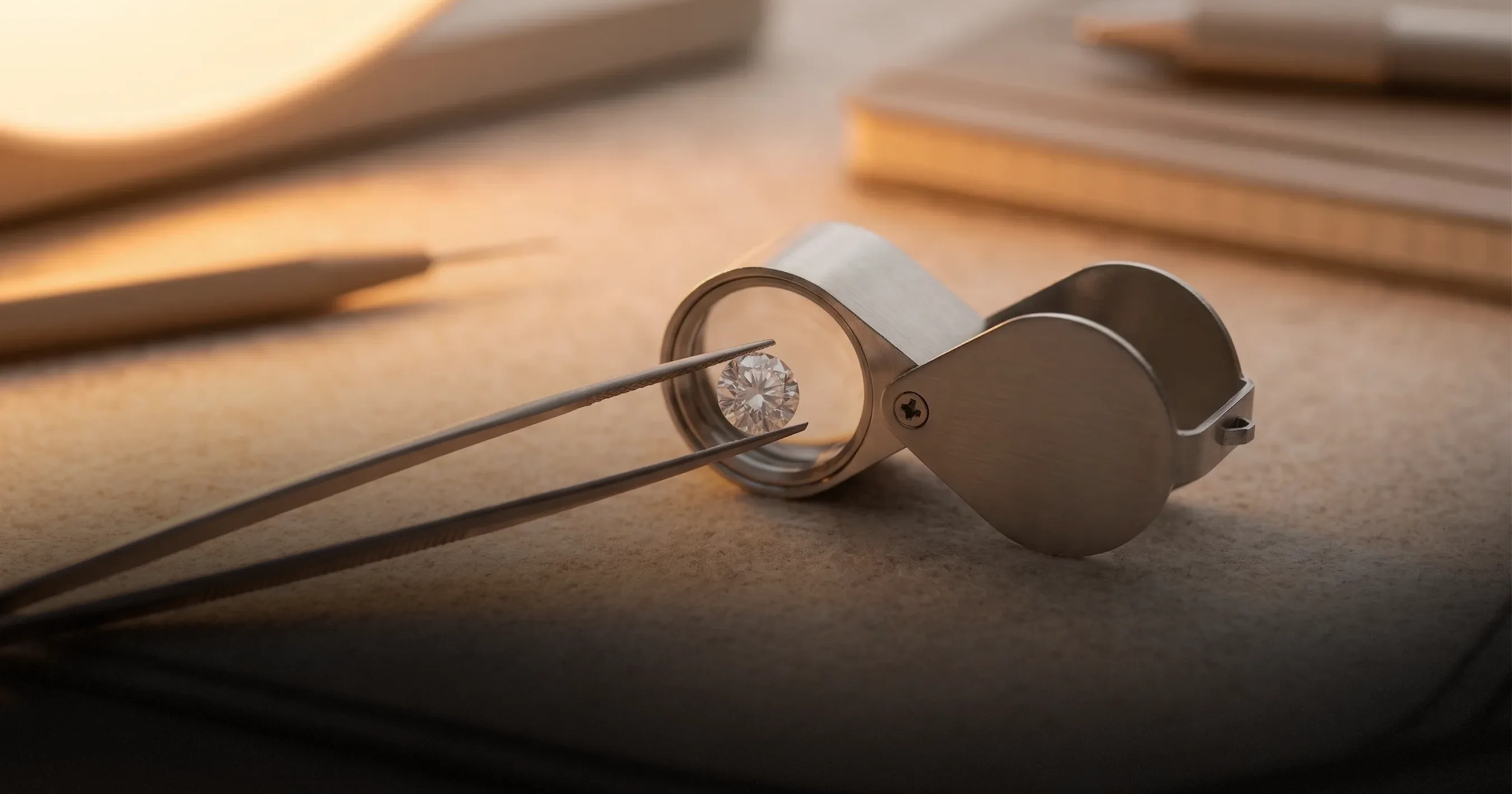
We use the phrase “ethically beautiful” often enough that it would be easy to let it drift into slogan territory — a nice pairing of words that sounds right and gets repeated until no one asks what it actually means. We would rather it did some work. So this is an attempt to unpack it properly: what we mean when we say a piece of jewellery does not have to choose between being beautiful and being honest, and why we think that claim needs to be earned rather than simply stated.
For us, “ethically beautiful” rests on three specific choices, not a general feeling of goodness. Every stone is grown, not mined. Every piece is made only once it has been ordered. And every design is built to be worn for years, not seasons. None of these three is a marketing flourish on its own — each is a practical decision about how a jewellery business can be run, and each has trade-offs worth being clear about.
A Phrase Worth Being Precise About
“Ethical” is one of the most overused words in jewellery marketing, partly because it is genuinely hard to verify from outside a business and partly because it can mean almost anything the speaker wants it to. We do not think that vagueness serves anyone — not us, and certainly not someone deciding whether to trust a brand with a significant purchase. So rather than asking for that trust upfront, we would rather explain the specific practices behind the phrase and let the reasoning stand or fall on its own.
That also means being honest about the limits of the claim. “Ethically beautiful” is not a certification, and it is not a comparative judgement against any other jeweller’s choices — mined diamonds have their own traceability and certification standards, and many jewellers work seriously and carefully within them. Our position is narrower: these are the choices we have made, here is the reasoning, and here is what we can point to in support of it.
Grown, Not Mined
Every diamond and coloured gemstone we set is grown in a laboratory rather than mined from the ground. This is not a lesser or approximate version of the real thing. A lab-grown diamond is produced using one of two established methods — high-pressure, high-temperature growth, which recreates the conditions under which natural diamonds form, or chemical vapour deposition, in which carbon is deposited onto a seed crystal inside a controlled chamber. The Gemological Institute of America, which trains and certifies gemologists worldwide, describes both processes in detail and confirms that the resulting stones share essentially the same chemical composition, crystal structure, and physical properties as their mined counterparts (GIA, n.d.-a; GIA, n.d.-b).
This is not just a brand claim — it is now reflected in how diamonds are regulated. In 2018, the US Federal Trade Commission revised its Jewelry Guides and removed the word “natural” from the basic definition of “diamond” altogether, on the grounds that laboratory-grown stones with the same optical, physical, and chemical properties as mined diamonds are also, by definition, diamonds. At the same time, the Commission requires that a lab-grown stone always be clearly disclosed as such — described as “laboratory-grown,” “laboratory-created,” or similar — so a buyer always knows a stone’s origin (Federal Trade Commission, 2018). We take the same view: grown and mined are both real, and the difference that matters is not authenticity, it is origin.
Natural diamonds, by contrast, are extracted through mining — a resource-intensive process tracked in detail by bodies such as the US Geological Survey, which publishes annual data on where natural diamond production comes from and how it is extracted (USGS, 2025). We are not going to claim that growing a stone in a laboratory has zero environmental footprint of its own — it does not, and any process that uses energy has a cost. What we can say plainly is that it does not require extracting material from the earth, which is a meaningfully different starting point. Both a lab-grown gemstone and a lab-grown diamond sit at Aurea as equal, standard offerings — neither one is positioned as the budget option, and the choice between them comes down to colour and preference, not category.
Made Only When It’s Chosen
The second part of “ethically beautiful” has less to do with the stone and more to do with timing. Nothing at Aurea is made before someone has chosen it. There is no finished stock sitting in a drawer, waiting to be discovered by the right buyer — a piece is only cut, set, and finished once an order is placed, a process that takes about twenty days before it is dispatched from Singapore and tracked to its destination, including throughout Japan.
We think this matters for a reason bigger than any one jewellery brand. Making things in anticipation of demand — rather than in response to it — is a well-documented driver of waste across consumer goods generally. In the fashion and apparel sector specifically, the United Nations Environment Programme has reported that the industry now produces around 92 million tonnes of textile waste every year, with clothing production roughly doubling between 2000 and 2015 while the average length of time a garment stays in use fell by around 36 percent over a similar period (UNEP, n.d.). We are not a fashion company and we are not claiming those exact figures apply to fine jewellery — the two industries are different in scale and material. But the underlying pattern they describe, of production running ahead of what is actually needed or wanted, is the same pattern a made-to-order model is built to avoid. Making a piece only once it is chosen is a smaller, calmer answer to a much larger problem, not a solution to it — but it is the part of the problem we can actually control.
It also changes the relationship a little. A piece made to order is not competing for attention on a shelf against forty near-identical alternatives; it exists because someone specifically wanted it. That is a slower way to sell jewellery than keeping inventory ready to ship the same day. We think it is the more honest one.
Designed to Outlast the Trends
The last part of the phrase is the one that is hardest to prove with a citation, because it is a judgement about design rather than a verifiable fact — but we think it belongs here anyway, because beauty that fades quickly is its own kind of waste. A piece that feels exciting for one season and dated the next has a short, if intense, life. We would rather make something that still feels right in ten years, which is a different and, in our experience, harder brief than chasing what feels current now.
That is why the collection stays deliberately small — thirteen styles, each considered on its own terms, rather than a sprawling catalogue refreshed every few months. Proportion and restraint do more work in that kind of design than embellishment does. A piece earns its place by being worn often, not admired occasionally.
What We Don’t Claim
It is worth being direct about where this reasoning stops. We are not saying lab-grown stones are inherently “better” than mined ones — only that they are different in origin and equally real, a distinction the GIA and the FTC both support. We are not saying made-to-order production erases the environmental cost of making anything at all — only that it avoids the specific waste of making things nobody has asked for. And we are not suggesting other jewellers who work with mined stones or hold stock are acting in bad faith — there are serious, careful businesses on every side of these choices. “Ethically beautiful” describes the specific standard we hold ourselves to, not a verdict on anyone else’s.
What we would ask is that the phrase be judged the way we intend it: as a description of working practices that can be checked, not a feeling that has to be taken on faith.
A Way of Working, Not a Slogan
So when we say a piece from Aurea is ethically beautiful, this is what we mean: the stone was grown, not pulled from the ground; the piece was made because someone chose it, not in advance of that choice; and the design was built to still feel right long after the moment it was bought. None of those three things is loud, and none of them is meant to be. They are simply the standard we hold every piece to, and the reasoning we would want if we were the one asking.
If you would like to see that standard applied to a specific piece, the collection is a good place to start. If you would rather talk it through first, a complimentary consultation with a jeweller is always the unhurried option — no pressure, no obligation, just a conversation about what “ethically beautiful” looks like for you.
Frequently Asked Questions
What does “ethically beautiful” mean at Aurea?
It describes three specific practices: every stone is grown in a laboratory rather than mined, every piece is made only after it has been ordered rather than kept as stock, and every design is intended to remain wearable and relevant for years rather than following short-term trends.
Are lab-grown diamonds real diamonds?
Yes. Lab-grown diamonds share essentially the same chemical composition, crystal structure, and physical and optical properties as mined diamonds, according to the Gemological Institute of America. The US Federal Trade Commission's Jewelry Guides also removed the word "natural" from the definition of diamond in 2018, while still requiring that lab-grown stones be clearly disclosed as such.
How are lab-grown diamonds made?
Lab-grown diamonds are produced using one of two methods: high-pressure, high-temperature (HPHT) growth, which recreates the conditions of natural diamond formation, or chemical vapour deposition (CVD), in which carbon is deposited onto a seed crystal inside a controlled chamber. Both are documented by the Gemological Institute of America.
Is made-to-order jewellery more sustainable than keeping stock?
Made-to-order production avoids making pieces that nobody has ordered, which sidesteps a specific form of waste. It does not eliminate the environmental cost of production altogether. The broader pattern of producing goods ahead of demand is a documented driver of waste in consumer industries such as fashion, and made-to-order is one way of avoiding that specific pattern.
Does Aurea treat lab-grown gemstones as a lower-cost alternative to diamonds?
No. Lab-grown gemstones and lab-grown diamonds are presented as equal, standard offerings at Aurea. Neither is positioned as the budget option; the choice between them comes down to colour and personal preference.
Mira Oduya
We Are Jewellers, Not Just Sellers | Aurea
Aurea on why we make fine jewellery to order, not sell it off a shelf: craft over churn, guidance over pressure, and a direct bond with the wearer.
Aurea Means Gold — and a Golden Standard
The story behind the Aurea name: a golden standard for how fine jewellery is grown, certified, made to order, and designed to outlast trends.
From Sketch to Hand: How an Aurea Piece Is Made | Aurea
Follow an Aurea piece from first sketch and certified stone to hand-set bench work and tracked dispatch from Singapore, made only once it's ordered.