
Behind the Craft
From Sketch to Hand: How an Aurea Piece Is Made | Aurea
Follow an Aurea piece from first sketch and certified stone to hand-set bench work and tracked dispatch from Singapore, made only once it's ordered.
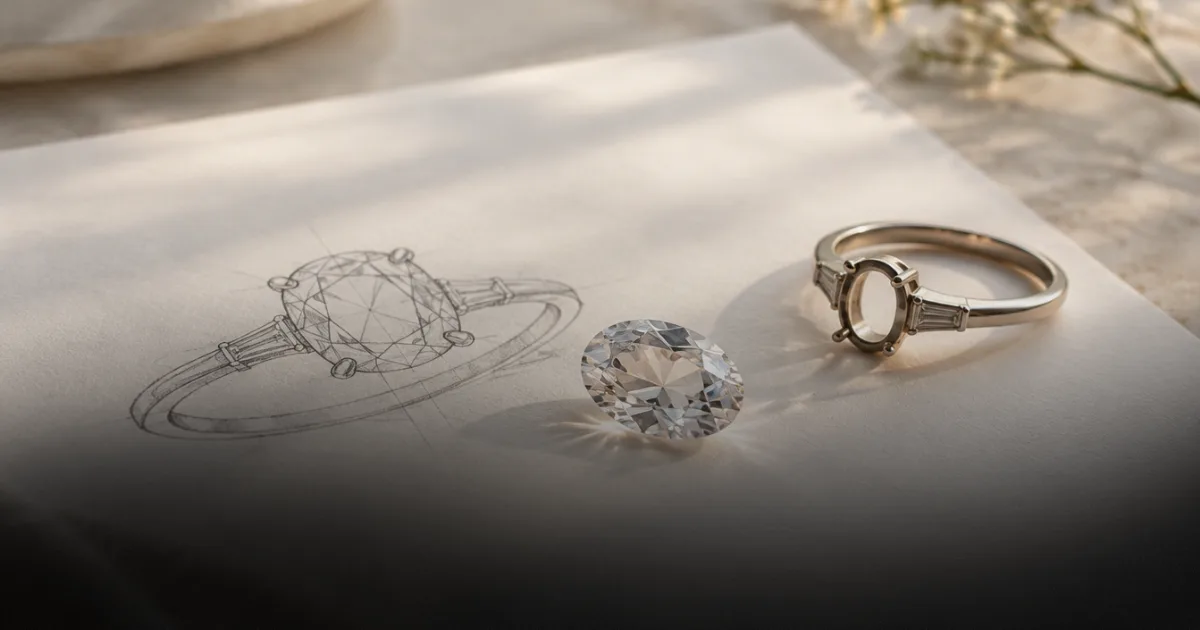
Before an order arrives, an Aurea workshop is, in a sense, empty. Not idle — sketches are pinned to the wall, stones are catalogued and certified, benches are set with tools laid out in careful rows — but empty of anything actually being made. That is deliberate. Nothing at Aurea is produced on the chance that someone might want it. A piece begins to exist, properly, only once someone has asked for it, and from that moment a quiet, unhurried sequence begins — the same one every time, ending roughly twenty days later with a small box leaving Singapore, addressed to somewhere specific.
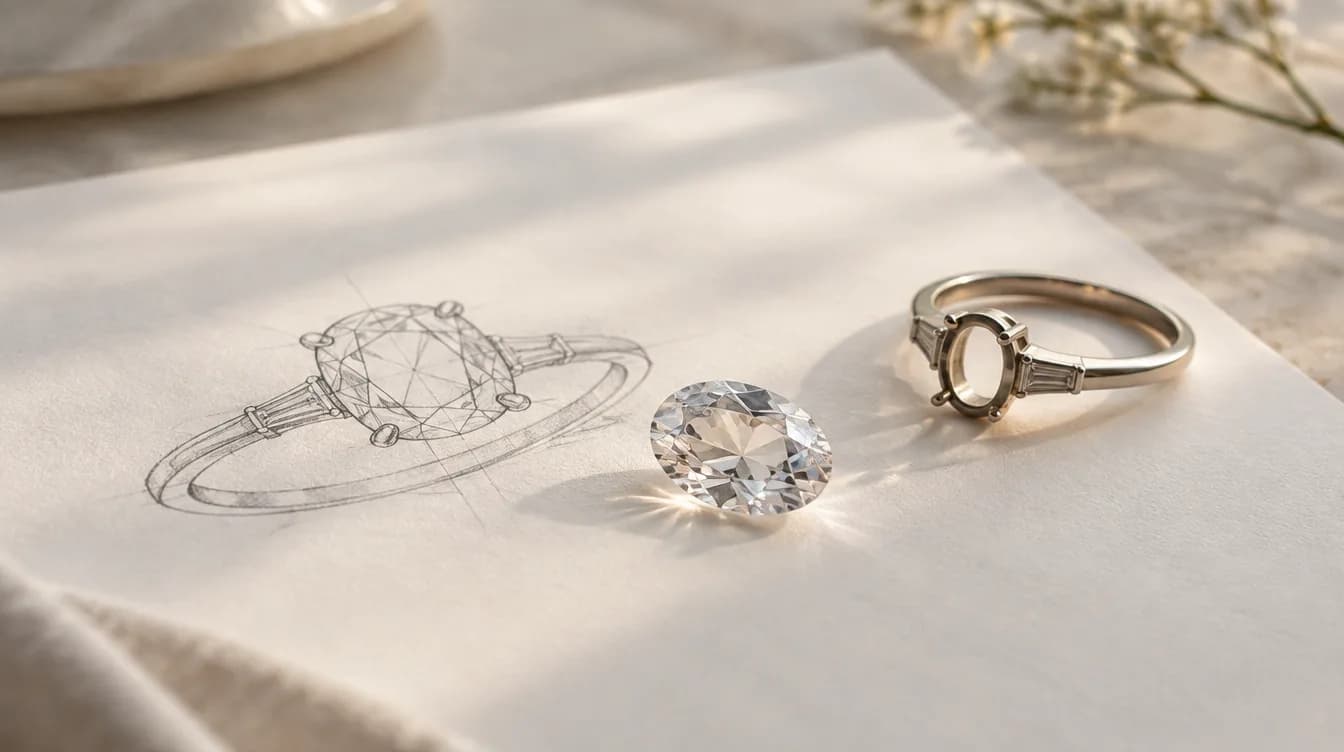
A Design, Already Resolved, Waiting to Be Chosen
The design comes first, and comes long before any order. Each of Aurea's thirteen styles — the Solitaire Ring, the Lantern Pendant, the Trilogy Ring, the Papillon Necklace, and the rest — was drawn, argued over, refined, and finished as an idea well before a single one existed as metal. A sketch becomes a specification: proportions, settings, the way a band tapers or a pendant catches light from a particular angle. What doesn't happen at this stage is production. A finished design is not a finished object; it is a proposal, held ready, waiting for someone to say yes to it.
That is also where a customer's part of the story usually begins — not at the bench, but at the sketch. Browsing the collection, working through Find Your Piece, or talking a shape through in a complimentary consultation are, in effect, the same act: choosing which resolved idea, out of thirteen, is about to become real.
Choosing the Stone
A style is only half the decision. The other half is colour, and at Aurea that choice is never a hierarchy. A lab-grown diamond and a lab-grown ruby, emerald, sapphire, pink sapphire, or light blue sapphire sit on equal footing — both real stones, both certified, neither treated as the budget option beside the other. The question a customer is really answering isn't diamond-or-something-less; it's simply which colour belongs on their hand, or around their neck.
This is also, quietly, the point at which the piece stops being general and starts being someone's. A Trilogy Ring set with clear stone reads differently to the same setting in emerald flanked by diamond. Once that choice is made, the piece has a shape and a colour, and can finally be made.
The Bench
What follows happens somewhere most customers never see, which is a shame, because it's the least hurried part of the whole process. A design file becomes a wax or metal model, precise enough to hold a stone to a fraction of a millimetre; that model is cast, then handed to a bench where filing, soldering, and polishing happen much as they have for centuries — by hand, under strong light, checked constantly against a loupe. There is no real shortcut for this stage. A ring can be modelled quickly on a screen, but turning that file into a band with the right weight in the hand and the right finish under a fingertip still takes a person sitting at a bench with a torch and a set of files, working at the pace the metal allows.
Setting the Stone
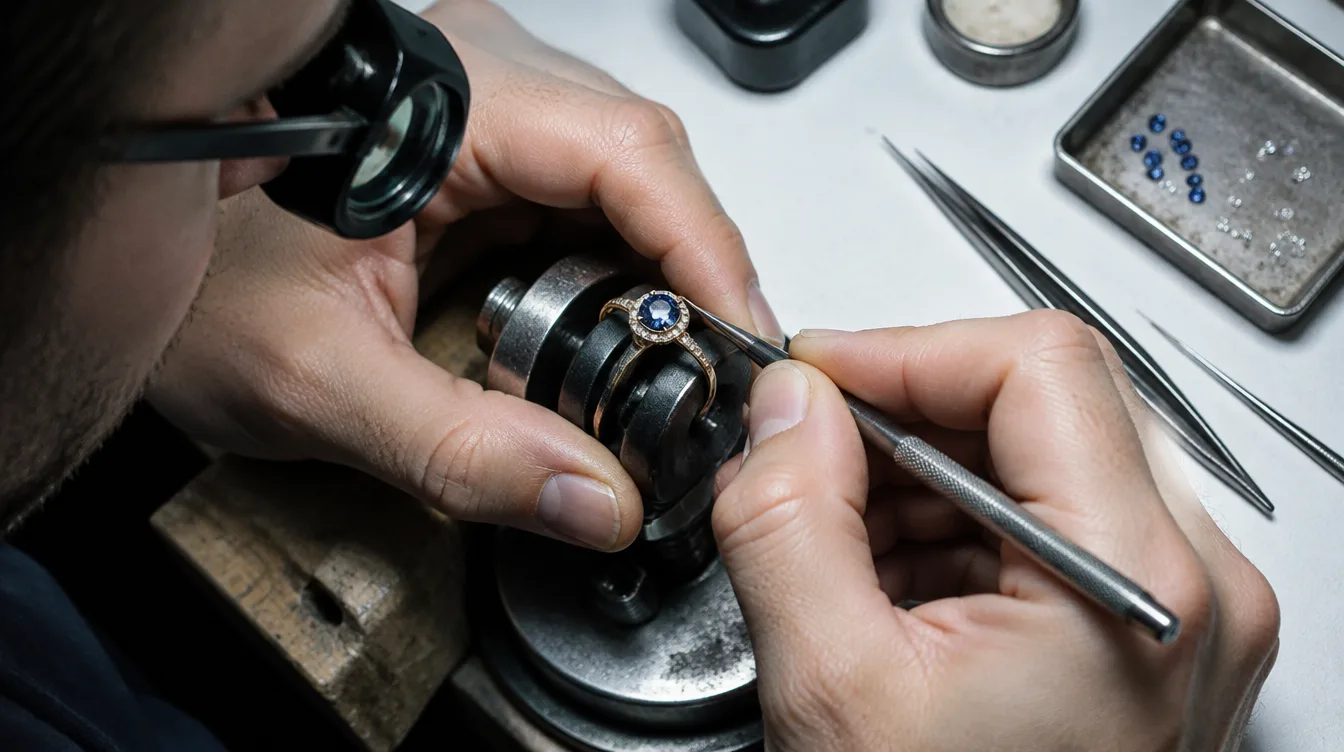
Setting is the part of the process with the least room for error, and worth explaining in full. Stone setting is widely described in the trade as work that requires patience and precision, where even a slightly uneven prong or a moment of carelessness can chip a stone or leave it loose (Cooksongold, n.d.) — a caution that applies whether the stone came from the ground or a laboratory. Aurea's deliberately small edit of thirteen styles exists partly because of this stage: a setter working across a narrow, well-understood range of settings can give each one full attention, rather than adapting quickly across dozens of unfamiliar designs. The stone is seated, the prongs or bezel closed around it by hand, and checked again under magnification before it is allowed to move on.
Certification
Before a stone ever reaches the bench, it has already been examined and certified — a process gemological laboratories run with a rigour worth appreciating briefly. GIA, the industry's standard-setting laboratory, grades each diamond through several independent stages: initial testing to confirm what the material actually is, colour assessed under standardised lighting by more than one grader, and clarity examined under ten-times magnification, with more experienced gemologists reviewing the findings before a grade is finalised (GIA, n.d.). Every stone Aurea uses, coloured gemstone or diamond, is held to that same standard of scrutiny and arrives with its own certification — so what comes with a finished piece isn't only a description of the stone, but a documented account of it.
Twenty Days, Then Singapore
All of this — sketch confirmed, stone chosen and certified, bench work, setting, a final polish and inspection — takes roughly twenty days from the moment an order is placed. Nothing is rushed to hit that window, and nothing sits finished and waiting once it is done; a piece is packed and dispatched from Singapore, with tracking, to wherever it is going, Japan included, as soon as it is ready. There is a certain honesty in that timeline. It isn't a shipping estimate padded to look generous — it is roughly how long it actually takes to do each of these stages properly, once, for one specific piece, rather than in batches made ahead of demand.
Nothing Sits in a Drawer
It would be faster, on paper, to make pieces in advance — to keep a small stock of popular styles in common stones, ready to ship the moment someone decides. Aurea doesn't do this, and the reason comes back to the same idea running through every stage above: a piece exists because someone asked for it, not because someone might. Nothing is cast, set, or certified on spec. Nothing sits finished in a drawer, waiting for a buyer to be found for it later. The twenty days between an order and its arrival are simply what it costs, in time, to keep that promise — a cost Aurea has chosen to keep paying, piece by piece, rather than solve by making things nobody has asked for yet.

If a design has already caught your eye, browse the collection to see where it might start. If you would rather talk it through first — the stone, the sizing, the timing around a particular date — a complimentary consultation puts a jeweller alongside you for exactly that conversation, at whatever pace suits you.
Mira Oduya
Writes about the bench, for Aurea
Mira spends most of her week around the bench, and writes about what actually happens there rather than the marketing version of it. She's interested in process, not polish.
We Are Jewellers, Not Just Sellers | Aurea
Aurea on why we make fine jewellery to order, not sell it off a shelf: craft over churn, guidance over pressure, and a direct bond with the wearer.
What ‘Ethically Beautiful’ Really Means | Aurea
What “ethically beautiful” means at Aurea: stones grown not mined, pieces made only once ordered, design built to outlast trends.
Aurea Means Gold — and a Golden Standard
The story behind the Aurea name: a golden standard for how fine jewellery is grown, certified, made to order, and designed to outlast trends.