
Education
How Lab-Grown Diamonds and Gemstones Are Made
How lab-grown diamonds and coloured gemstones are grown, not mined: HPHT, CVD, and hydrothermal methods explained plainly, with sourcing from GIA and IGI.
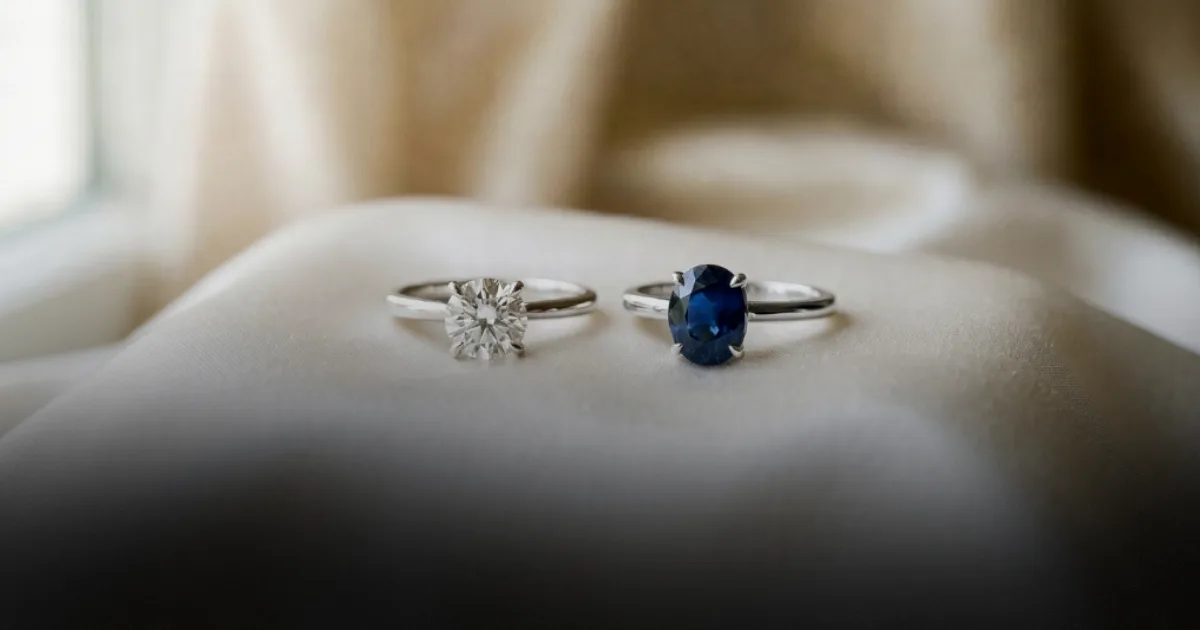
At Aurea, every diamond and every coloured gemstone we set is grown, not mined. We say this plainly, on the homepage and on every product page, because it is the fact our customers most want explained. Grown by what, exactly? And is the result really the same stone as one pulled from the ground?
The short answer is yes. The longer answer — how a diamond or a ruby actually comes into being inside a laboratory, over weeks rather than millions of years — is worth telling properly. Not as a technical lecture, but as the kind of thing a jeweller would explain to you across the counter, before you ever asked.
What “Lab-Grown” Actually Means
“Lab-grown” is not a softer word for imitation. A cubic zirconia or a moissanite is a simulant — a different mineral entirely, shaped and polished to resemble a diamond. A lab-grown diamond is not an imitation of anything. It is carbon, arranged in the same crystal lattice as a mined diamond, formed under conditions that reproduce — in a controlled setting, over a much shorter timeframe — the same physics that forms a diamond deep in the earth.
The Gemological Institute of America (GIA), the standard-setting laboratory for diamond grading worldwide, states that lab-grown diamonds have “essentially the same chemical, physical and optical properties as its natural counterpart” (GIA). The International Gemological Institute (IGI) goes further, noting that lab-grown diamonds “exhibit identical optical, chemical, and physical properties to natural diamonds” (IGI). Same carbon. Same crystal structure. Same 10 on the Mohs hardness scale. Only the origin — laboratory versus riverbed or kimberlite pipe — differs.
The same principle holds for coloured gemstones. A lab-grown ruby is corundum, the same mineral as a mined ruby, coloured by the same trace element, chromium. A lab-grown emerald is beryl. The chemistry does not change depending on where the crystal formed.
How Lab-Grown Diamonds Are Made
Two methods produce the diamonds used in fine jewellery today: HPHT and CVD. Both start with a diamond seed — a small sliver of existing diamond — and both end, weeks later, with a rough crystal ready to be cut and polished exactly as a mined stone would be.
HPHT: High-Pressure, High-Temperature
HPHT recreates the conditions under which diamonds form naturally, compressed instead into a matter of days to weeks. A diamond seed is placed inside a press capable of extreme pressure — reportedly above 870,000 pounds per square inch — at temperatures of roughly 1,300–1,600°C (GIA). A carbon source, typically graphite, dissolves into a molten metal solution and slowly crystallises onto the seed, layer by layer, until a rough diamond has formed.
CVD: Chemical Vapour Deposition
CVD takes a gentler route. A diamond seed sits inside a sealed chamber filled with carbon-rich gas, commonly methane. A controlled energy source — typically a microwave beam — breaks the gas down into a plasma, and carbon atoms drift down and bond to the seed one atomic layer at a time. The chamber runs cooler than an HPHT press, at roughly 900–1,200°C, over a period of three to four weeks (GIA).
Neither method leaves a mark on the finished stone that the eye can detect. Distinguishing a lab-grown diamond from a mined one requires laboratory equipment and a trained gemologist studying growth patterns invisible to the naked eye, not a jeweller’s loupe (GIA).
How Lab-Grown Coloured Gemstones Are Made
Coloured gemstones — the rubies, sapphires, pink and light blue sapphires, and emeralds in Aurea’s collection — are grown by older methods than diamond synthesis, some dating back more than a century. Two approaches account for most of the fine coloured gemstones grown today.
Hydrothermal growth
Hydrothermal growth imitates the heat and pressure found deep within the earth, using a water-based solution instead of a diamond press. The raw mineral ingredients dissolve in that solution under sustained heat and pressure, then crystallise around a seed as the solution cools — much as natural crystals form around mineral-rich groundwater underground (International Gem Society). It is the primary method used to grow emerald and one of the two most common methods for sapphire.
Flux growth
Flux growth uses a different kind of solvent — a flux, which behaves at high temperature the way water dissolves sugar, allowing the mineral ingredients to dissolve and then slowly recrystallise as the temperature drops (GIA). It is a patient process: a single crystal of gem quality can take the better part of a year to grow. Flux-grown rubies and sapphires are prized for the same rich, even colour that patient natural formation produces.
A related melt process — flame fusion, developed in 1902 and still the most economical method for corundum — produces synthetic ruby and sapphire more quickly, though the results are generally considered a lower grade than hydrothermal or flux-grown material (GIA; International Gem Society). Aurea’s coloured gemstones are grown, not flame-fused, in keeping with our standard of choosing the better process over the cheaper one.
Grown, Not Mined — But the Same Stone
This is the point worth sitting with: origin is the only variable. A lab-grown diamond is graded on the same 4Cs — cut, colour, clarity, and carat — as a mined diamond, by the same laboratories, to comparable standards. GIA and IGI both issue dedicated Laboratory-Grown Diamond Reports, using clearly labelled terminology so nothing is left ambiguous, but the underlying grading criteria are drawn from the same decades of diamond science (GIA). IGI notes it was “the world’s first gemological institute to grade lab grown diamonds,” and uses the same colour and clarity scales it applies to natural stones (IGI).
At Aurea, every stone — diamond or coloured gemstone — is certified, and neither is treated as the value option. We ask customers to choose between them on colour and design, not on some imagined hierarchy of “real” and “less real.” A ruby is a ruby. A diamond is a diamond. The certificate that accompanies your piece says so in writing.
Addressing the Question We Hear Most
We understand why some people hesitate. “Lab-grown” sits, in casual conversation, uncomfortably close to lab-made simulants like cubic zirconia or moissanite — materials that look similar at a glance but are chemically nothing like diamond. We would rather answer that concern directly than avoid it. A simulant is a different mineral wearing diamond’s appearance. A lab-grown diamond is diamond, verified by the same laboratories that have graded mined diamonds for a century. The distinction is not a matter of opinion; it is chemistry, confirmed by gemological science and stated plainly by the institutions responsible for it.
Why This Matters for a Piece You Will Wear for Years
Fine jewellery is a considered purchase, whether you are choosing it for yourself or for someone you love. Understanding how your stone came to be — the seed, the chamber, the weeks of careful growth — does not change how it catches the light. It simply means you are buying with the full picture, not a partial one. That is the standard we hold ourselves to at Aurea: every stone grown, every stone certified, every piece made only once it is yours, and never a claim made that a laboratory couldn’t stand behind.
Frequently Asked Questions
Are lab-grown diamonds real diamonds? Yes. A lab-grown diamond has the same carbon crystal structure, hardness, and optical properties as a mined diamond. Gemological laboratories such as GIA and IGI grade them using the 4Cs and issue certification confirming their properties (GIA; IGI).
What is the difference between HPHT and CVD diamonds? HPHT uses extreme pressure and heat to crystallise carbon onto a seed, similar to natural formation conditions but compressed into weeks. CVD grows a diamond more gradually inside a gas-filled chamber, building it up atom by atom at lower pressure. Both produce genuine diamond; the methods differ in process, not in the chemistry of the result (GIA).
How are lab-grown coloured gemstones made? Most are grown using hydrothermal or flux methods, which recreate the heat, pressure, and mineral-rich conditions that form gemstones underground, over weeks to months rather than millions of years (International Gem Society).
Are lab-grown stones certified the same way as mined stones? Yes, with clear labelling. Leading laboratories issue dedicated reports for lab-grown stones using the same grading criteria as for mined stones, so the certification is specific but the standard is shared (GIA).
A Standard We’re Happy to Explain in Person
If you would like to talk through any of this before choosing a piece — for yourself, or for someone whose milestone you are marking — book a complimentary consultation and a jeweller will walk you through it, without pressure. You are also welcome to explore the rest of our Education section, or begin with Find Your Piece if you are not yet sure where to start.
Mira Oduya
The 4Cs, Explained Simply: Cut, Colour, Clarity, and Carat
A clear, calm guide to the 4Cs of diamonds — cut, colour, clarity, and carat — and how they apply equally to lab-grown stones. From Aurea.
How to Find Your Ring Size at Home
A calm, practical guide to measuring your ring size at home using string, paper, or a ring you own — plus how Japanese sizing differs.