
Education
Lab-Grown vs. Cubic Zirconia: Why They're Not the Same Thing
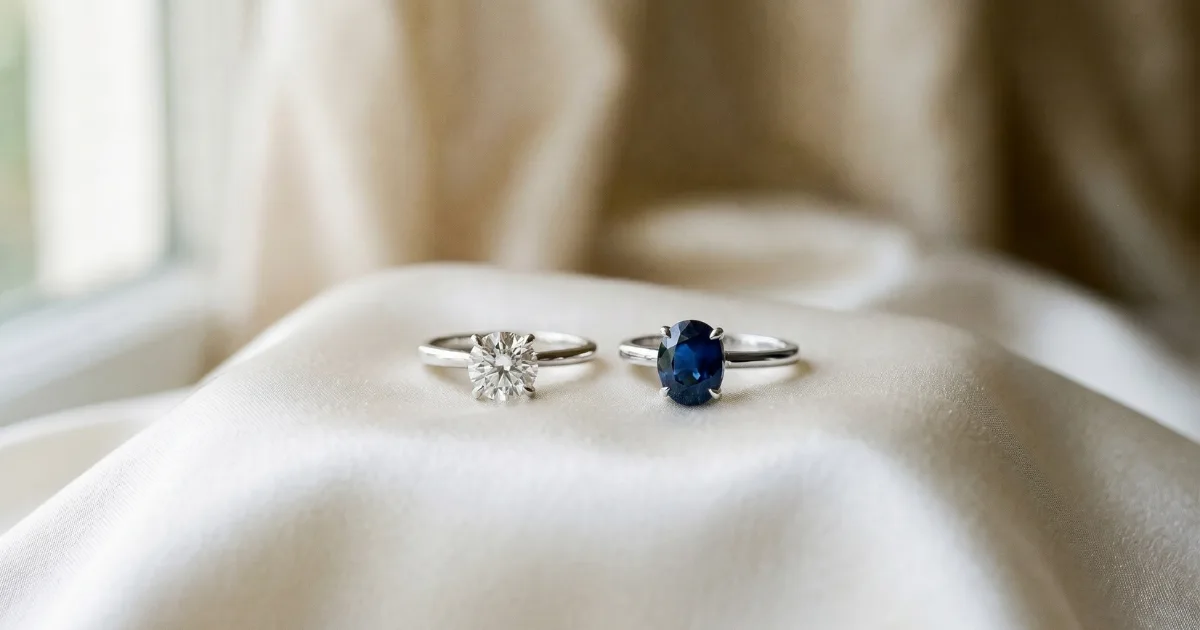
If you have spent any time comparing lab-grown diamond vs cubic zirconia, you have probably run into the same assumption more than once: that “lab-grown” is simply a nicer name for cubic zirconia, or a compromise dressed up in kinder marketing. It is a fair question to ask, and an easy mix-up to make. The two are often mentioned in the same breath as “affordable diamond alternatives,” and under gallery lighting, a well-cut example of either can catch the eye. But a lab-grown diamond and a cubic zirconia are not the same category of stone. One is a diamond. The other, however well made, is not. The difference is not a matter of marketing language. It is chemistry, and it can be measured.
A Question Worth Answering Properly
We would rather explain this once, plainly, than have you wonder about it quietly while you shop. At Aurea, every diamond in our collection is lab-grown, and every coloured gemstone is too — there is no mined option in the catalogue, by design. That is a meaningful shift from how fine jewellery has traditionally been sold, so a moment of scepticism is entirely reasonable. Many of our customers are choosing a piece for themselves, often to mark a milestone or simply because it is time, and a considered purchase deserves a straight answer rather than a sales line. So here is the straight answer: a lab-grown diamond is chemically, physically, and optically a diamond. Cubic zirconia is a different mineral altogether, styled to resemble one.
What a Lab-Grown Diamond Actually Is
A lab-grown diamond begins as a small diamond seed placed in a chamber that recreates the pressure and temperature conditions under which diamond forms, then carbon is added until it crystallises into a full diamond, atom by atom, in the same tightly bonded lattice as a mined stone. As the Gemological Institute of America (GIA) puts it, laboratory-grown diamonds “have the same crystal structure, consisting of tightly bonded carbon atoms” as their mined counterparts.
There is no shortcut in the chemistry — the growing method changes, but the result is carbon, arranged as diamond. Source: GIA — Simulants, Moissanite and Lab-Grown Diamonds [1]
That is also why lab-grown diamonds are graded, not simply rated for appearance. GIA offers dedicated laboratory-grown diamond reports, laser-inscribing each stone it evaluates so its origin is permanently and transparently identified. It is assessed as a diamond, on diamond terms, because it is one. Source: GIA — Laboratory-Grown Diamond Report [2]
What Cubic Zirconia Actually Is
Cubic zirconia is a manufactured crystal made from zirconium oxide, produced by heating the powdered compound until it forms a clear, colourless crystal that can be cut and set like a gemstone. Source: GIA — An Introduction to Imitation Diamonds & Other Gems [3]
It is not a failed diamond or a “budget diamond” in the way it is sometimes described — it is a distinct material with its own manufacturing process and its own chemistry, one that has quietly done an honest job as a diamond simulant for decades. The confusion only sets in when it is marketed, even loosely, as a stand-in for the real thing rather than what it is: a different stone entirely.
Where the Difference Shows Up: Hardness
The clearest, most measurable difference between the two is hardness. Diamond, lab-grown or mined, sits at 10 on the Mohs scale, the top of the scale and the hardest naturally occurring material used in jewellery. Source: GIA 4Cs — Mohs Scale, Gem and Mineral Hardness [4]. Cubic zirconia sits at roughly 8.5 [3].
That gap of a point and a half sounds small until you consider what shares the lower end of daily life with it — household dust contains quartz, which measures around 7, hard enough to gradually dull a cubic zirconia's facets over years of ordinary wear. A diamond's facets stay sharp against nearly everything it will ever brush against, because almost nothing you encounter day to day is harder than it is. This is not a claim about which stone looks better. It is a fact about which one keeps its edge.
Certification: The Paper Trail That Tells You What You're Wearing
A lab-grown diamond can be certified as a diamond because independent gemological laboratories test and confirm that it is one, using the same 4Cs — cut, colour, clarity, and carat — applied to any diamond, alongside an inscription confirming its lab-grown origin [2]. Cubic zirconia is not diamond-certified, for the simple reason that it was never claiming to be a diamond in the first place; it is sold and priced on its own terms.
This distinction is not just semantic — it sits inside consumer-protection rules that most established jewellery markets take seriously. In the United States, for example, the Federal Trade Commission's guidance requires that simulants such as cubic zirconia be described using clear qualifying language such as “imitation” or “simulated,” rather than the word “diamond” alone, and that lab-grown diamonds may only be marketed as diamonds when they genuinely share a mined diamond's optical, physical, and chemical properties. Source: FTC — In the Loupe: Advertising Diamond, Gemstones and Pearls [5]. The naming is not a courtesy. It is a requirement, precisely because the materials are provably different.
At Aurea, this is also why every stone we set — diamond or coloured gemstone — is certified before it reaches you. Certification is not a marketing flourish here; it is the answer to exactly the question this post is trying to settle.
Why the Two Get Confused, and Why That Is Understandable
The mix-up is not a sign of not knowing your gemstones — it is a reasonable response to how the market has looked until recently. Cubic zirconia was, for a long time, the only widely available, affordable alternative to a mined diamond, so a generation of shoppers learned to associate “affordable and diamond-like” with cubic zirconia by default. Lab-grown diamonds are a newer, less familiar category by comparison, even though the science behind them has existed for decades. Add to that the fact that both stones can look convincingly bright in a product photo, and the assumption that they must be variations on the same idea is an easy one to arrive at honestly. It deserves a clear answer, not a defensive one.
Choosing With Confidence, Not Just a Budget
Because every stone Aurea sets, from a lab-grown diamond to a lab-grown ruby, sapphire, emerald, pink sapphire, or light blue sapphire, is grown, certified, and made only once it is ordered, we present lab-grown gemstones and lab-grown diamonds as equal, standard offerings rather than a premium tier and a lesser one. Both are real. Both are certified. Neither is the compromise option. The decision worth making is about colour, setting, and the piece that feels like yours — not about which stone is “trying” to be a diamond and which one actually is. If you are choosing a piece to mark something of your own, that is a distinction worth having settled before you decide, not after.
Frequently Asked Questions
Is a lab-grown diamond the same as cubic zirconia?
No. A lab-grown diamond is carbon crystallised into the same structure as a mined diamond, while cubic zirconia is a manufactured crystal made from zirconium oxide. They are different materials with different chemistry, hardness, and certification standards.
Is a lab-grown diamond a real diamond?
Yes. A lab-grown diamond has the same chemical composition, crystal structure, and physical properties as a mined diamond. The only difference is where it formed — underground over time, or in a controlled setting that recreates the same conditions.
What is the actual difference between a lab-grown diamond and cubic zirconia?
The core difference is chemistry: a lab-grown diamond is pure carbon in a diamond crystal lattice, while cubic zirconia is zirconium oxide. This shows up most clearly in hardness — diamond rates 10 on the Mohs scale, cubic zirconia around 8.5 — and in how each is certified and legally described.
Does cubic zirconia scratch or dull over time?
It can. At roughly 8.5 on the Mohs scale, cubic zirconia is softer than everyday materials like quartz-based household dust, so its facets can dull gradually with years of regular wear. A diamond, at 10 on the Mohs scale, is harder than nearly everything it will come into contact with.
How do I know a lab-grown diamond is genuinely certified?
Look for a grading report from an established gemological laboratory, such as GIA, which grades lab-grown diamonds on the same 4Cs used for mined diamonds and laser-inscribes the stone to confirm its lab-grown origin. At Aurea, every diamond and gemstone is certified before it is set.
Is a lab-grown diamond more expensive than cubic zirconia?
Generally, yes — a lab-grown diamond is priced as a diamond, reflecting its 4Cs, while cubic zirconia is priced as a simulant. At Aurea, lab-grown diamonds and lab-grown coloured gemstones are presented as equal, standard offerings, with pricing shown in Japanese yen and US dollars at checkout.
A Straight Answer, So You Can Choose Freely
A lab-grown diamond and a cubic zirconia will never be the same thing, no matter how the light catches either one. One is carbon, grown into a diamond. The other is a different mineral, made to resemble one. Knowing the difference is not about picking a side — it is about choosing your own piece with the facts settled, rather than a lingering doubt in the back of your mind. If you would like to talk it through in more depth, our consultation is complimentary and unhurried, or you are welcome to browse the Education section for more on how our stones are grown, graded, and cared for.
Mira Oduya
The 4Cs, Explained Simply: Cut, Colour, Clarity, and Carat
A clear, calm guide to the 4Cs of diamonds — cut, colour, clarity, and carat — and how they apply equally to lab-grown stones. From Aurea.
How to Find Your Ring Size at Home
A calm, practical guide to measuring your ring size at home using string, paper, or a ring you own — plus how Japanese sizing differs.