
Education
What a Diamond Certificate Actually Tells You
What does a diamond certificate actually mean? A clear guide to the 4Cs, GIA and IGI reports, and why certification applies equally to lab-grown stones.
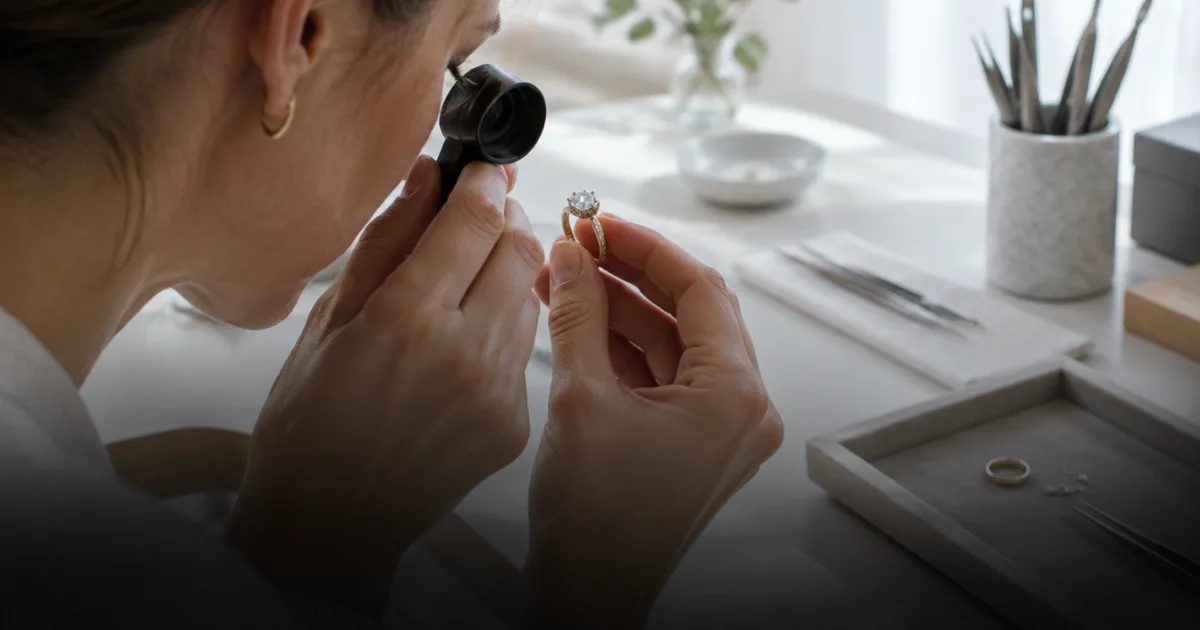
When you're choosing a piece of fine jewellery from a screen rather than a counter, a certificate is the one document that tells you, in writing, exactly what you're buying. It comes from a laboratory with no stake in the sale — not from the retailer — and it says the same thing whether you're standing in a shop or clicking “add to cart” from home. For a first-time buyer, particularly one purchasing sight unseen, that independence is the entire point.
This guide walks through what a diamond certificate — properly called a grading report — actually contains, which laboratories issue them, how the 4Cs are assessed, and why the same standard of certification applies whether a stone was grown in a laboratory or drawn from the ground. At Aurea, every stone we set, diamond or coloured gemstone, is certified before it reaches you, so understanding the document matters as much as understanding the stone itself.
What a Diamond Certificate Actually Is
A diamond certificate is not a receipt, an appraisal, or a warranty. It is a technical report produced by an independent gemological laboratory that has examined one specific stone, under controlled lighting and fixed magnification, and recorded exactly what that stone is. The trade body Jewelers of America describes a grading report plainly as “a blueprint of a diamond or gem's properties that verifies its authenticity and quality,” produced by graders working independently of “diamond and gem suppliers, mines or retailers” (Jewelers of America, n.d.).
Each report carries a unique number, tied permanently to that one stone and often laser-inscribed on its girdle, invisible to the naked eye. That number is what lets anyone verify, later, that the certificate matches the stone in front of them, rather than a different stone entirely.
The 4Cs, and What Each One Actually Measures
Every diamond grading report is built around four measurements known as the 4Cs: cut, colour, clarity, and carat weight. According to the Gemological Institute of America (GIA), which originated the 4Cs system, each is assessed through a specific, repeatable process (GIA, n.d.):
Colour is graded on a D-to-Z scale, compared against a set of master stones under standardised lighting, with multiple independent graders reaching consensus before a grade is finalised.
Clarity is assessed at 10x magnification, with any internal or surface characteristics mapped onto a plot that matches the stone's own shape.
Cut is measured against proportion, symmetry, and polish data, weighed against modelled light-performance studies rather than appearance alone.
Carat weight is recorded to the hundredth of a carat, using a precision micro-balance.
Together, these four figures let two buyers on opposite sides of the world compare two diamonds they will never hold side by side.
Which Laboratories Issue These Reports
Not every document calling itself a “certificate” comes from a laboratory worth trusting. The distinction that matters is independence: a credible report comes from a lab with no financial interest in the specific stone being sold, assessed by more than one grader against a published standard. Jewelers of America names GIA, IGI, GCAL, GSI, and EGL USA among the recognised independent laboratories (Jewelers of America, n.d.).
In fine jewellery, the two names you will see most often are:
GIA (Gemological Institute of America) — the non-profit research body that originated the 4Cs and remains the most widely recognised name in diamond grading (GIA, n.d.).
IGI (International Gemological Institute) — an independent laboratory operating globally since 1975, and currently the largest issuer of grading reports for lab-grown diamonds specifically (IGI, n.d.).
One detail worth knowing if you ever compare two reports side by side: since October 2025, GIA no longer assigns lab-grown diamonds the same specific-grade language it uses for natural diamonds. Instead, laboratory-grown stones GIA evaluates are classified as either “Premium” or “Standard,” based on thresholds across colour, clarity, polish, symmetry, and cut, rather than a precise letter and grade (GIA, 2025). GIA's stated reasoning is that a manufactured product does not need the exact scale built originally for natural stones. IGI, by contrast, continues to grade lab-grown diamonds on the same traditional 4Cs scale used for natural diamonds — the full D-to-Z colour range and standard clarity grades (IGI, n.d.). Neither approach says anything about the quality of a given stone; they are two labs presenting the same underlying facts in different formats. What matters to a buyer is simply knowing which system a report is using.
Certification Applies to Lab-Grown Stones, Fully
A lab-grown diamond is graded with the same rigour as a mined one because it is, physically, the same material — the same carbon crystal structure, the same hardness, the same fire. The only fact a laboratory records differently is origin: where and how the stone formed. That is exactly why every credible report states plainly whether a diamond is natural or laboratory-grown, and it is not a footnote. Regulators, including the US Federal Trade Commission, require that disclosure to appear with equal prominence to the word “diamond” itself in any advertising, and equivalent language for coloured gemstones (FTC, n.d.).
At Aurea, this is the substance behind “grown, not mined.” Every diamond and every coloured gemstone we set is laboratory-grown, and every one is certified. There is no natural-mined tier sitting above a lab-grown one, and no discount tier sitting quietly underneath it — certification exists for both, to the same standard, because both are real stones that deserve the same proof.
What About Coloured Gemstones
Ruby, sapphire, and emerald do not have a single, globally standardised numerical grading scale the way diamonds do — colour and clarity in coloured stones are described rather than scored, even among mined stones. What a coloured gemstone certificate reliably confirms is identity: the report states what the stone actually is, whether it is natural or laboratory-grown, and discloses any treatments. GIA's colored stone identification reports, for instance, exist specifically to “identify and describe a material and list detectable treatments” (GIA, n.d.).
For a lab-grown ruby or sapphire, that identification matters at least as much as it does for a diamond, precisely because colour alone tells a buyer nothing about origin. A certificate is what closes that gap.
Why This Matters When You Are Buying Online
If you are buying fine jewellery without holding the piece first, which is how most of our customers in Japan shop with us, a certificate does the work that a jeweller's loupe and a shop counter would otherwise do in person. It is not a marketing document. It is independent, third-party proof that the stone described in a listing is the stone that arrives, with the specifications stated.
That matters more, not less, when a purchase is made on trust and a photograph. It is also why certification at Aurea is never something to request separately — every piece is certified as a matter of course, alongside the made-to-order process that begins only once a piece is confirmed.
Reading Your Certificate When It Arrives
A few things are worth checking once a certificate is in hand:
The report number matches any inscription on the stone itself.
The 4Cs, or for lab-grown diamonds the classification, match what was described at the point of sale.
The issuing laboratory is named clearly, and its report can be looked up directly through that laboratory's own website using the report number.
For coloured stones, the report states species and growth origin plainly, alongside any treatments.
None of this requires expertise. It takes a few minutes and the number printed on the report.
A Closing Note
A certificate will not tell you whether a piece suits you, or whether a setting catches the light the way you had hoped — that is a more personal question, and one we are glad to talk through directly. If you would like to talk through what a certificate means for a particular piece, or anything else before you buy, book a complimentary consultation with a jeweller, or spend a little longer in our Education section, where the rest of these questions are answered in the same spirit: written to be read once, and understood.
Frequently Asked Questions
What is a diamond certificate?
A diamond certificate, or grading report, is an independent laboratory's written assessment of a diamond's 4Cs — cut, colour, clarity, and carat — along with identifying details such as measurements and any inscription, issued by a lab with no financial stake in the sale.
Do lab-grown diamonds come with certificates?
Yes. Lab-grown diamonds are graded and certified by the same laboratories that grade natural diamonds, including GIA and IGI, and every credible report states clearly whether a diamond is natural or laboratory-grown.
What is the difference between a GIA and an IGI report for a lab-grown diamond?
IGI grades lab-grown diamonds on the full traditional 4Cs scale, the same one used for natural diamonds. Since October 2025, GIA instead classifies the lab-grown diamonds it evaluates as “Premium” or “Standard,” rather than assigning a specific colour and clarity grade.
Do coloured gemstones like ruby, sapphire, and emerald come with certificates too?
Yes. Coloured gemstone identification reports confirm a stone's species, whether it is natural or laboratory-grown, and any treatments — though coloured stones are not scored on the same numerical scale diamonds use.
How do I check that a diamond certificate is genuine?
Look up the report number directly on the issuing laboratory's own website and confirm it matches the stone's stated details and any laser inscription.
Mira Oduya
The 4Cs, Explained Simply: Cut, Colour, Clarity, and Carat
A clear, calm guide to the 4Cs of diamonds — cut, colour, clarity, and carat — and how they apply equally to lab-grown stones. From Aurea.
How to Find Your Ring Size at Home
A calm, practical guide to measuring your ring size at home using string, paper, or a ring you own — plus how Japanese sizing differs.