
Learn
How to Clean Fine Jewellery at Home | Aurea
A gentle, jeweller-approved guide to cleaning fine jewellery at home safely — including lab-grown diamonds and gemstones.
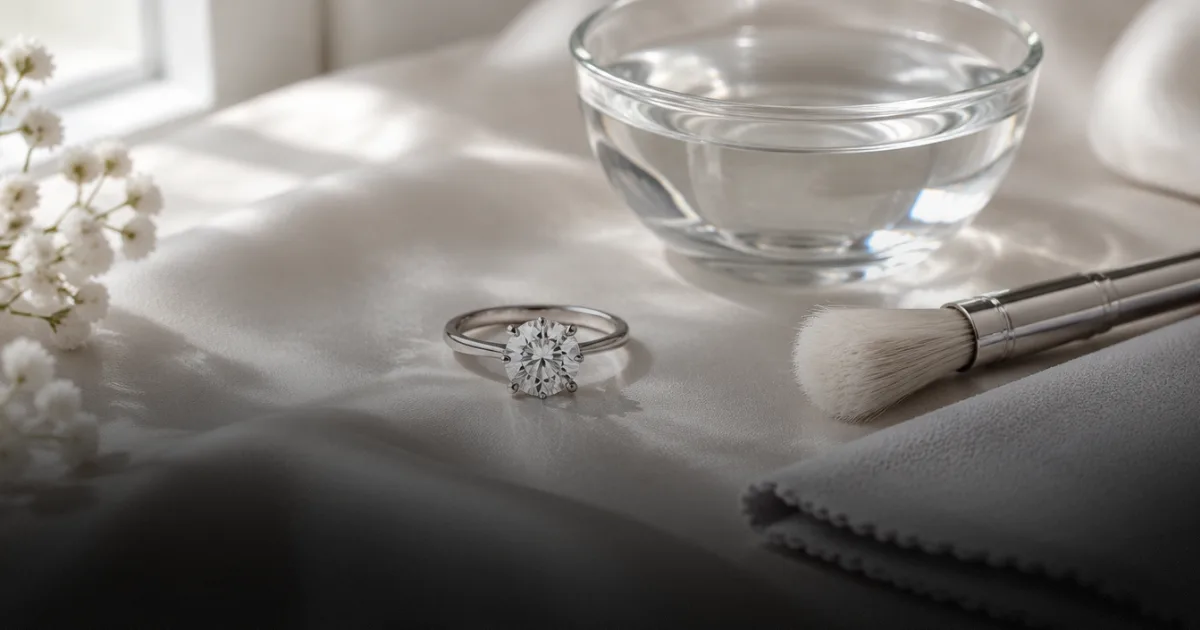
Fine jewellery is meant to be worn — across a keyboard, over dinner, on the school run — and worn jewellery meets the ordinary residue of a day: hand cream, perfume, soap, and simple dust. None of that is damage, but it does build up, and after a few weeks it's usually what makes a stone look duller than it actually is. The good news is that keeping fine jewellery clean rarely calls for anything more specialised than warm water, mild soap, and a soft brush. This guide covers the safest way to clean fine jewellery at home, the handful of things worth avoiding, and how the approach holds up when a piece is set with a lab-grown diamond or a lab-grown coloured gemstone rather than a mined one.
The Safest Way to Clean Fine Jewellery at Home
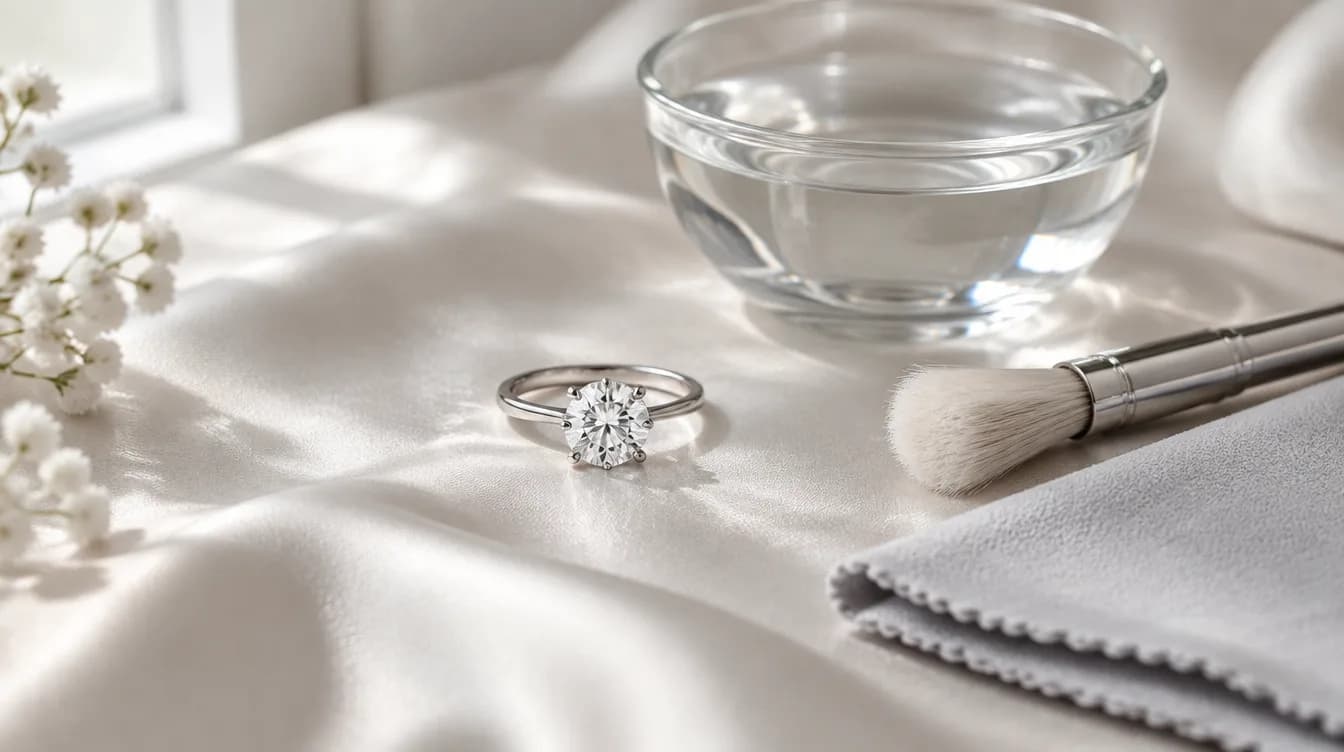
For the great majority of fine jewellery — rings, pendants, bracelets, earrings, in gold or platinum settings — the gentlest method is also the most reliable one, and it uses nothing that isn't already in most bathrooms.
Fill a small bowl with warm, not hot, water and a few drops of mild, fragrance-free soap.
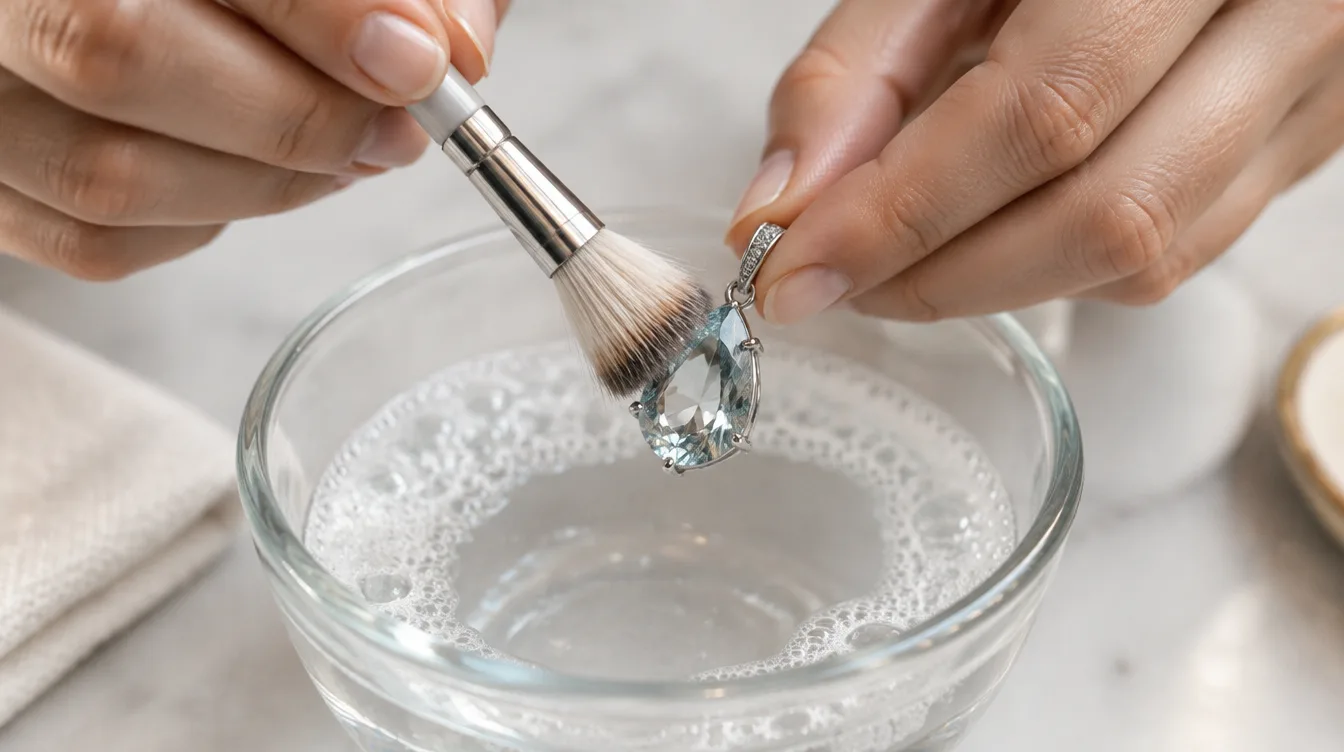
Let the piece soak for two to three minutes — long enough to loosen everyday build-up without doing anything to the metal or the stone.
Brush gently with a soft-bristled brush (a clean, unused soft toothbrush works well), paying particular attention to the underside of the setting, where oils and residue tend to collect out of sight.
Rinse under lukewarm running water, with the drain stoppered or a cloth laid over it, so nothing is lost by accident.
Pat dry with a soft, lint-free cloth and let the piece air-dry fully before it goes back into a box or pouch.
It's broadly the same approach recommended across the trade: Blue Nile's own jewellery-care guide walks through the same warm water, mild soap, and soft-brush sequence as a routine most people can manage at home (Blue Nile, n.d.). Some diamond-specific guides go a step further and suggest soaking diamond solitaires in an ammonia-based cleaner such as window cleaner (GIA, n.d.-a). We'd treat that as optional rather than necessary — ammonia is unforgiving of softer metals, coloured gemstones, and enamel detail, and most fine jewellery today sets a diamond alongside other stones or finishing on the same piece. Warm water and mild soap gets a piece properly clean without needing to think about what else is set beside the diamond.
What to Avoid When Cleaning Fine Jewellery
A short list of things worth leaving out of the routine, however tempting they look as a shortcut:
Chlorine bleach and household chemicals. The GIA is direct on this point: chlorine, as found in household bleach, “should never be used” on fine jewellery, since it can pit or discolour metal and weaken the prongs holding a stone in place over time (GIA, n.d.-a).
Toothpaste, baking soda, and other abrasives. The same guidance covers anything gritty. It might look like a reasonable stand-in for polish, but it's abrasive enough to scratch softer metals and dull a polished finish (GIA, n.d.-a).
Ultrasonic cleaners, for some stones and settings. Ultrasonic cleaners have their place in a jeweller's workshop, but the GIA cautions that they're not safe for every gem. Fracture-filled stones — emeralds treated with oil or resin to improve clarity are a common example — can lose that filling to the vibration, and organic materials such as pearl, coral, and amber can be damaged outright (GIA, n.d.-b). Heat-sensitive stones including opal, tanzanite, and turquoise carry their own risks. If there's any doubt about how a stone has been treated, the simplest rule is to leave the ultrasonic machine to a professional who can check first.
Hardness Isn't the Whole Story
It's worth understanding why a stone's hardness doesn't automatically mean it's indestructible in a cleaning routine. The Mohs scale ranks diamond at 10, the hardest known natural material, with sapphire and ruby — both varieties of the mineral corundum — close behind at 9. But the GIA points out that durability actually rests on three separate qualities: hardness (resistance to scratching), toughness (resistance to chipping or breaking), and stability (resistance to chemicals, heat, and light) (GIA, n.d.-c). A stone can rank highly on hardness and still be vulnerable elsewhere — emerald, for instance, is hard enough for jewellery but notably lacking in toughness, which is exactly why its common oil and resin treatments are so easily undone by solvents or ultrasonic cleaning (GIA, n.d.-c). It's a useful reminder that gentle, universal care serves a whole piece better than assuming any one stone is invincible because of where it sits on a hardness chart.
Caring for Lab-Grown Diamonds and Gemstones
None of the advice above changes for a lab-grown stone, and that's really the point. The GIA describes lab-grown diamonds as having “essentially the same chemical, physical and optical properties” as their mined counterparts (GIA, n.d.-d) — the same carbon structure, the same hardness of 10, the same fire and brilliance. The origin of a diamond has no bearing on how it should be cleaned or looked after; a lab-grown solitaire is cared for exactly as a mined one would be.
The same logic carries across to coloured gemstones. A lab-grown sapphire is still corundum; a lab-grown emerald is still beryl. The mineral species — and therefore its hardness, toughness, and sensitivity to particular treatments — comes from what the stone is, not from whether it formed underground over millions of years or in a controlled setting over a matter of weeks. At Aurea, every stone we set, diamond or coloured gemstone, is lab-grown and certified, and we treat lab-grown diamonds and lab-grown gemstones as equal, standard offerings rather than a premium-versus-budget choice. That extends to care: choose a piece on colour, not on any assumption that one stone needs to be handled more carefully than another.
How Often to Clean, and When to Bring in a Professional
A light clean every couple of weeks suits jewellery worn most days, with a slightly more thorough version every season or so for anything worn occasionally — a piece kept for a particular anniversary or a Mother's Day gift, say, rather than daily wear. It's worth glancing over the setting itself while cleaning, too, not just the stone: the GIA recommends checking that prongs are still holding a stone securely, since a piece can work loose gradually without ever looking obviously damaged (GIA, n.d.-a).
If a piece still looks dull after a proper clean at home, or a prong feels the slightest bit loose, that's the point to bring in a professional rather than reach for anything stronger. A jeweller can assess a stone's treatment history and setting before using an ultrasonic or steam cleaner, which is a safer sequence than guessing at home. If a specific piece raises a question — a family stone of uncertain treatment, an intricate halo setting, or simply not being sure — a complimentary consultation is a straightforward way to ask before doing anything.
Between Wears
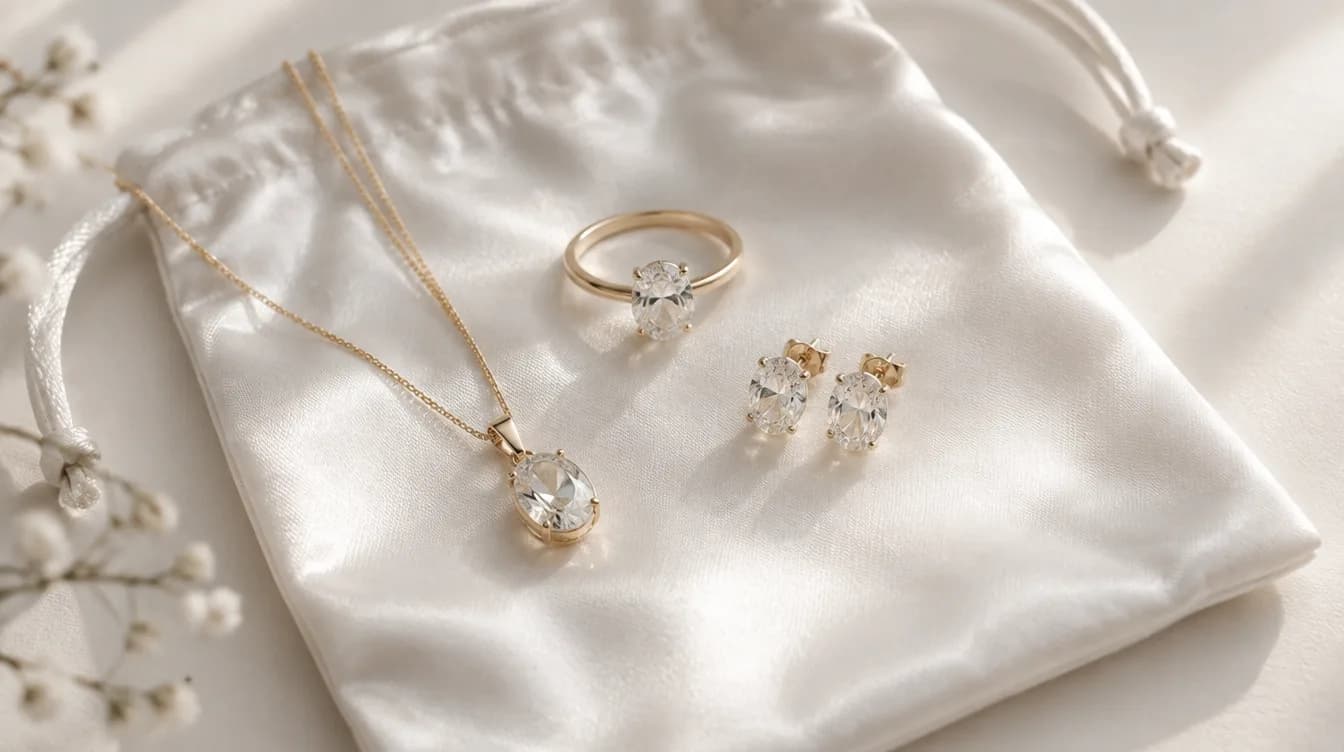
Storage matters more than it's usually given credit for. Keep pieces separated, ideally in individual soft pouches or a lined compartment, since a diamond left loose against a softer stone or a delicate chain can scratch it without anyone noticing until later. A drawer or box kept out of direct sunlight and away from humidity is enough — no special equipment required, just a little separation and consistency.
A Few Minutes, Done Regularly
None of this asks for anything beyond patience, warm water, and a soft brush, applied a little more regularly than most people manage. Every Aurea piece, whatever stone it carries, is designed to be worn often and looked after simply. If a question comes up about a particular setting or stone, book a complimentary consultation and a jeweller will talk it through directly — no pressure, no obligation. For more on how lab-grown stones are made, graded, and certified, the Education section carries the same straightforward approach applied elsewhere: everything we'd tell you across the counter, written down instead.
Frequently Asked Questions
Can I clean my fine jewellery with just soap and water?
Yes. Mild, fragrance-free soap and warm water, applied with a soft brush, is the safest routine for most fine jewellery, including diamonds and lab-grown gemstones. It avoids the risks that stronger chemicals or abrasives carry.
Is it safe to clean lab-grown diamonds the same way as mined diamonds?
Yes. Lab-grown and mined diamonds share the same chemical structure and hardness, so the same gentle cleaning routine applies to both without any adjustment.
Can I put my jewellery in an ultrasonic cleaner?
It depends on the stone and any treatments it has had. Ultrasonic cleaners can damage fracture-filled or oil-treated stones such as many emeralds, and organic materials like pearl. If there is any doubt, a professional jeweller can check a stone's treatment history before using one.
How often should I clean my fine jewellery?
A light clean every couple of weeks suits daily wear, with a more thorough clean every season or so for pieces worn less often.
Theo Lindqvist
Writes about stones, for Aurea
Theo answers the questions people ask before they buy — about origin, certification, and what a stone actually is. He'd rather a piece read plainly than impressively.
The Right Way to Store Your Jewellery | Aurea
A calm, practical guide to storing fine jewellery so it stays scratch-free, tangle-free, and safe from humidity — at home and while travelling.
Everyday Wear vs Special Occasion Jewellery | Aurea
A calm, evidence-based guide to what fine jewellery can handle every day, and the moments worth removing it for: sport, swimming, cleaning, and cosmetics.
Fine Jewellery Warranty and Care Explained | Aurea
A calm guide to how fine jewellery warranties work, why your certificate and receipt matter, and how Aurea supports your piece long after it arrives.